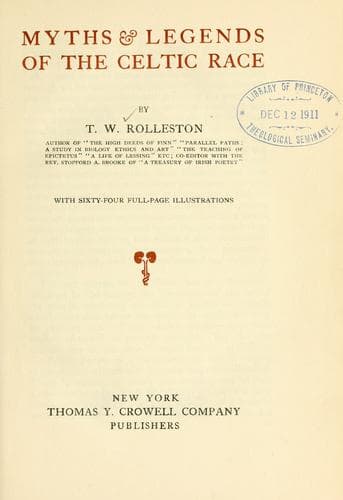
Myths & Legends of the Celtic RaceRolleston, T. W. (Thomas William)
Religion
Myths & Legends of the Celtic Race
Rolleston, T. W. (Thomas William)
Celts -- Religion; Mythology, Celtic
were extracted from his head he must die; it was accordingly sewn up with
golden thread, and the king was bidden to keep himself from horse-riding
and from all vehement passion and exertion, and he would do well.
Seven years afterwards Conor saw the sun darken at noonday, and he
summoned his Druid to tell him the cause of the portent. The Druid, in a
magic trance, tells him of a hill in a distant land on which stand three
crosses with a human form nailed to each of them, and one of them is like
the Immortals. “Is he a malefactor?” then asks Conor. “Nay,” says the
Druid, “but the Son of the living God,” and he relates to the king the
story of the death of Christ. Conor breaks out in fury, and drawing his
sword he hacks at the oak-trees in the sacred grove, crying, “Thus would I
deal with his enemies,” when with the excitement and exertion the
brain-ball bursts from his head, and he falls dead. And thus was the
vengeance of Mesgedra fulfilled. With Conor and with Cuchulain the glory
of the Red Branch and the dominance of Ulster passed away. The next, or
Ossianic, cycle of Irish legend brings upon the scene different
characters, different physical surroundings, and altogether different
ideals of life.
*Ket and the Boar of mac Datho*
The Connacht champion Ket, whose main exploit was the wounding of King
Conor at Ardnurchar, figures also in a very dramatic tale entitled “The
Carving of mac Datho’s Boar.” The story runs as follows:
Once upon a time there dwelt in the province of Leinster a wealthy
hospitable lord named Mesroda, son of Datho. Two possessions had he;
namely, a hound which could outrun every other hound and every wild beast
in Erin, and a boar which was the finest and greatest in size that man had
ever beheld.
Now the fame of this hound was noised all about the land, and many were
the princes and lords who longed to possess it. And it came to pass that
Conor King of Ulster and Maev Queen of Connacht sent messengers to mac
Datho to ask him to sell them the hound for a price, and both the
messengers arrived at the dūn of mac Datho on the same day. Said the
Connacht messenger: “We will give thee in exchange for the hound six
hundred milch cows, and a chariot with two horses, the best that are to be
found in Connacht, and at the end of a year thou shalt have as much
again.” And the messenger of King Conor said: “We will give no less than
Connacht, and the friendship and alliance of Ulster, and that will be
better for thee than the friendship of Connacht.”
Then Mesroda mac Datho fell silent, and for three days he would not eat or
drink, nor could he sleep o’ nights, but tossed restlessly on his bed. His
wife observed his condition, and said to him: “Thy fast hath been long,
Mesroda, though good food is by thee in plenty; and at night thou turnest
thy face to the wall, and well I know thou dost not sleep. What is the
cause of thy trouble?”
Public-domain text, read in full here on John Shaqi.
Reviews
Reviews
No reviews yet
Be the first to share your thoughts on this work.
Elsewhere in the archive
Join the Discussion
Join the discussion
Sign in to leave a comment or review.
Sign InorCreate an account