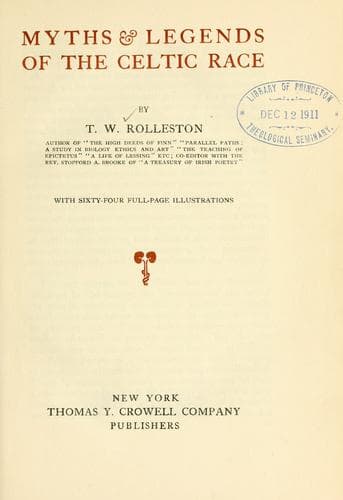
Myths & Legends of the Celtic RaceRolleston, T. W. (Thomas William)
Religion
Myths & Legends of the Celtic Race
Rolleston, T. W. (Thomas William)
Celts -- Religion; Mythology, Celtic
One of the most interesting and attractive of the relics of Ossianic
literature is the “Colloquy of the Ancients,” _Agallamh na Senorach_, a
long narrative piece dating from about the thirteenth century. It has been
published with a translation in O’Grady’s “Silva Gadelica.” It is not so
much a story as a collection of stories skilfully set in a mythical
framework. The “Colloquy” opens by presenting us with the figures of
Keelta mac Ronan and Oisīn son of Finn, each accompanied by eight
warriors, all that are left of the great fellowship of the Fianna after
the battle of Gowra and the subsequent dispersion of the Order. A vivid
picture is given us of the grey old warriors, who had outlived their
epoch, meeting for the last time at the dūn of a once famous chieftainess
named Camha, and of their melancholy talk over bygone days, till at last a
long silence settled on them.
*Keelta Meets St. Patrick*
Finally Keelta and Oisīn resolve to part, Oisīn, of whom we hear little
more, going to the Fairy Mound, where his Danaan mother (here called Blai)
has her dwelling, while Keelta takes his way over the plains of Meath till
he comes to Drumderg, where he lights on St. Patrick and his monks. How
this is chronologically possible the writer does not trouble himself to
explain, and he shows no knowledge of the legend of Oisīn in the Land of
Youth. “The clerics,” says the story, “saw Keelta and his band draw near
them, and fear fell on them before the tall men with the huge wolf-hounds
that accompanied them, for they were not people of one epoch or of one
time with the clergy.” Patrick then sprinkles the heroes with holy water,
whereat legions of demons who had been hovering over them fly away into
the hills and glens, and “the enormous men sat down.” Patrick, after
inquiring the name of his guest, then says he has a boon to crave of
him—he wishes to find a well of pure water with which to baptize the folk
of Bregia and of Meath.
*The Well of Tradaban*
Keelta, who knows every brook and hill and rath and wood in the country,
thereon takes Patrick by the hand and leads him away “till,” as the writer
says, “right in front of them they saw a loch-well, sparkling and
translucid. The size and thickness of the cress and of the _fothlacht_, or
brooklime, that grew on it was a wonderment to them.” Then Keelta began to
tell of the fame and qualities of the place, and uttered an exquisite
little lyric in praise of it:
“O Well of the Strand of the Two Women, beautiful are thy cresses,
luxuriant, branching; since thy produce is neglected on thee thy brooklime
is not suffered to grow. Forth from thy banks thy trout are to be seen,
thy wild swine in the wilderness; the deer of thy fair hunting crag-land,
thy dappled and red-chested fawns! Thy mast all hanging on the branches of
the trees; thy fish in estuaries of the rivers; lovely the colours of thy
purling streams, O thou that art azure-hued, and again green with
reflections of surrounding copse-wood.”(184)
Public-domain text, read in full here on John Shaqi.
Reviews
Reviews
No reviews yet
Be the first to share your thoughts on this work.
Elsewhere in the archive
Join the Discussion
Join the discussion
Sign in to leave a comment or review.
Sign InorCreate an account