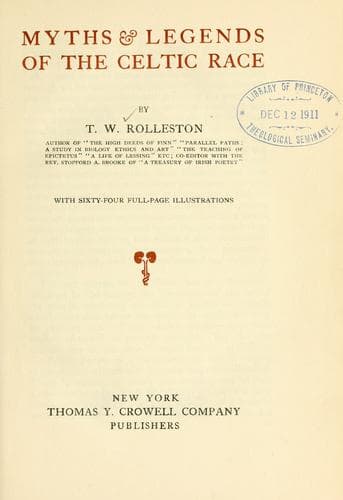
Myths & Legends of the Celtic RaceRolleston, T. W. (Thomas William)
Religion
Myths & Legends of the Celtic Race
Rolleston, T. W. (Thomas William)
Celts -- Religion; Mythology, Celtic
We now come to the work in which the chief treasures of Cymric myth and
legend were collected by Lady Charlotte Guest sixty years ago, and given
to the world in a translation which is one of the masterpieces of English
literature. The title of this work, the “Mabinogion,” is the plural form
of the word _Mabinogi_, which means a story belonging to the equipment of
an apprentice-bard, such a story as every bard had necessarily to learn as
part of his training, whatever more he might afterwards add to his
_répertoire_. Strictly speaking, the _Mabinogi_ in the volume are only the
four tales given first in Mr. Alfred Nutt’s edition, which were entitled
the “Four Branches of the Mabinogi,” and which form a connected whole.
They are among the oldest relics of Welsh mythological saga.
*Pwyll, Head of Hades*
The first of them is the story of Pwyll, Prince of Dyfed, and relates how
that prince got his title of _Pen Annwn_, or “Head of Hades”—Annwn being
the term under which we identify in Welsh literature the Celtic Land of
the Dead, or Fairyland. It is a story with a mythological basis, but
breathing the purest spirit of chivalric honour and nobility.
Pwyll, it is said, was hunting one day in the woods of Glyn Cuch when he
saw a pack of hounds, not his own, running down a stag. These hounds were
snow-white in colour, with red ears. If Pwyll had had any experience in
these matters he would have known at once what kind of hunt was up, for
these are the colours of Faëry—the red-haired man, the red-eared hound are
always associated with magic.(228) Pwyll, however, drove off the strange
hounds, and was setting his own on the quarry when a horseman of noble
appearance came up and reproached him for his discourtesy. Pwyll offered
to make amends, and the story now develops into the familiar theme of the
Rescue of Fairyland. The stranger’s name is Arawn, a king in Annwn. He is
being harried and dispossessed by a rival, Havgan, and he seeks the aid of
Pwyll, whom he begs to meet Havgan in single combat a year hence.
Meanwhile he will put his own shape on Pwyll, who is to rule in his
kingdom till the eventful day, while Arawn will go in Pwyll’s shape to
govern Dyfed. He instructs Pwyll how to deal with the foe. Havgan must be
laid low with a single stroke—if another is given to him he immediately
revives again as strong as ever.
Pwyll agreed to follow up the adventure, and accordingly went in Arawn’s
shape to the kingdom of Annwn. Here he was placed in an unforeseen
difficulty. The beautiful wife of Arawn greeted him as her husband. But
when the time came for them to retire to rest he set his face to the wall
and said no word to her, nor touched her at all until the morning broke.
Then they rose up, and Pwyll went to the hunt, and ruled his kingdom, and
did all things as if he were monarch of the land. And whatever affection
he showed to the queen in public during the day, he passed every night
even as this first.
Public-domain text, read in full here on John Shaqi.
Reviews
Reviews
No reviews yet
Be the first to share your thoughts on this work.
Elsewhere in the archive
Join the Discussion
Join the discussion
Sign in to leave a comment or review.
Sign InorCreate an account