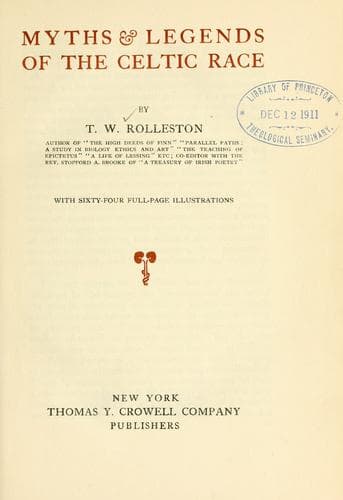
Myths & Legends of the Celtic RaceRolleston, T. W. (Thomas William)
Religion
Myths & Legends of the Celtic Race
Rolleston, T. W. (Thomas William)
Celts -- Religion; Mythology, Celtic
Near to the castle of Narberth, where Pwyll had his court, there was a
mound called the Mound of Arberth, of which it was believed that whoever
sat upon it would have a strange adventure: either he would receive blows
and wounds or he would see a wonder. One day when all his lords were
assembled at Narberth for a feast Pwyll declared that he would sit on the
mound and see what would befall.
He did so, and after a little while saw approaching him along the road
that led to the mound a lady clad in garments that shone like gold, and
sitting on a pure white horse. “Is there any among you,” said Pwyll to his
men, “who knows that lady?” “There is not,” said they. “Then go to meet
her and learn who she is.” But as they rode towards the lady she moved
away from them, and however fast they rode she still kept an even distance
between her and them, yet never seemed to exceed the quiet pace with which
she had first approached.
Several times did Pwyll seek to have the lady overtaken and questioned,
but all was in vain—none could draw near to her.
Next day Pwyll ascended the mound again, and once more the fair lady on
her white steed drew near. This time Pwyll himself pursued her, but she
flitted away before him as she had done before his servants, till at last
he cried : “O maiden, for the sake of him thou best lovest, stay for me.”
“I will stay gladly,” said she, “and it were better for thy horse had thou
asked it long since.”
Pwyll then questioned her as to the cause of her coming, and she said: “I
am Rhiannon, the daughter of Hevydd Hēn,(230) and they sought to give me
to a husband against my will. But no husband would I have, and that
because of my love for thee; neither will I yet have one if thou reject
me.” “By heaven!” said Pwyll, “if I might choose among all the ladies and
damsels of the world, thee would I choose.”
They then agree that in a twelvemonth from that day Pwyll is to come and
claim her at the palace of Hevydd Hēn.
Pwyll kept his tryst, with a following of a hundred knights, and found a
splendid feast prepared for him, and he sat by his lady, with her father
on the other side. As they feasted and talked there entered a tall,
auburn-haired youth of royal bearing, clad in satin, who saluted Pwyll and
his knights. Pwyll invited him to sit down. “Nay, I am a suitor to thee,”
said the youth; “to crave a boon am I come.” “Whatever thou wilt thou
shalt have,” said Pwyll unsuspiciously, “if it be in my power.” “Ah,”
cried Rhiannon, “wherefore didst thou give that answer?” “Hath he not
given it before all these nobles?” said the youth; “and now the boon I
crave is to have thy bride Rhiannon, and the feast and the banquet that
are in this place.” Pwyll was silent. “Be silent as long as thou wilt,”
said Rhiannon. “Never did man make worse use of his wits than thou hast
done.” She tells him that the auburn-haired young man is Gwawl, son of
Clud, and is the suitor to escape from whom she had fled to Pwyll.
Public-domain text, read in full here on John Shaqi.
Reviews
Reviews
No reviews yet
Be the first to share your thoughts on this work.
Elsewhere in the archive
Join the Discussion
Join the discussion
Sign in to leave a comment or review.
Sign InorCreate an account