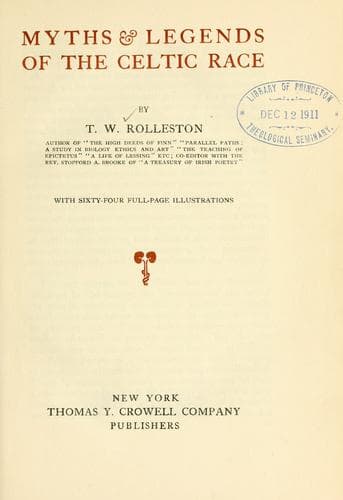
Myths & Legends of the Celtic RaceRolleston, T. W. (Thomas William)
Religion
Myths & Legends of the Celtic Race
Rolleston, T. W. (Thomas William)
Celts -- Religion; Mythology, Celtic
This conception of the question episode seems to me radically different
from that which was adopted in the Welsh version. It is characteristic of
Peredur that he always does as he is told by proper authority. The
question was a test of obedience and self-restraint, and he succeeded in
the ordeal. In fairy literature one is often punished for curiosity, but
never for discretion and reserve. The Welsh tale here preserves, I think,
the original form of the story. But the French writers mistook the
omission to ask questions for a failure on the part of the hero, and
invented a shallow and incongruous theory of the episode and its
consequences. Strange to say, however, the French view found its way into
later versions of the Welsh tale, and such a version is that which we have
in the “Mabinogion.” Peredur, towards the end of the story, meets with a
hideous damsel, the terrors of whose aspect are vividly described, and who
rebukes him violently for not having asked the meaning of the marvels at
the castle: “Hadst thou done so the king would have been restored to
health, and his dominions to peace. Whereas from henceforth he will have
to endure battles and conflicts, and his knights will perish, and wives
will be widowed, and maidens will be left portionless, and all this is
because of thee.” I regard this loathly damsel as an obvious interpolation
in the Welsh tale. She came into it straight out of the pages of
Chrestien. That she did not originally belong to the story of Peredur
seems evident from the fact that in this tale the lame lord who bids
Peredur refrain from asking questions is, according to the damsel, the
very person who would have benefited by his doing so. As a matter of fact,
Peredur never does ask the question, and it plays no part in the
conclusion of the story.
Chrestien’s unfinished tale tells us some further adventures of Perceval
and of his friend and fellow-knight, Gauvain, but never explains the
significance of the mysterious objects seen at the castle. His
continuators, of whom Gautier was the first, tell us that the Graal was
the Cup of the Last Supper and the lance that which had pierced the side
of Christ at the Crucifixion; and that Peredur ultimately makes his way
back to the castle, asks the necessary question, and succeeds his uncle as
lord of the castle and guardian of its treasures.
*Wolfram von Eschenbach*
In the story as given by Wolfram von Eschenbach, who wrote about the year
1200—some twenty years later than Chrestien de Troyes, with whose work he
was acquainted—we meet with a new and unique conception of the Grail. He
says of the knights of the Grail Castle:
“Si lebent von einem steine
Des geslähte ist vîl reine . . .
Es heizet _lapsit [lapis] exillîs_,
Der stein ist ouch genannt der Grâl.”(244)
Public-domain text, read in full here on John Shaqi.
Reviews
Reviews
No reviews yet
Be the first to share your thoughts on this work.
Elsewhere in the archive
Join the Discussion
Join the discussion
Sign in to leave a comment or review.
Sign InorCreate an account