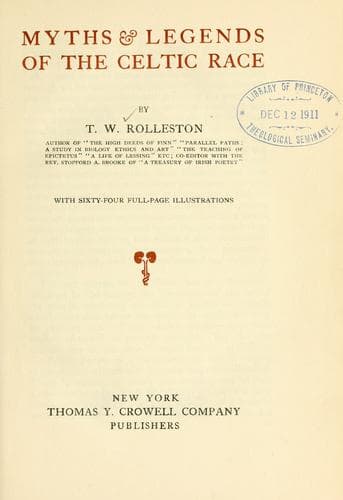
Myths & Legends of the Celtic RaceRolleston, T. W. (Thomas William)
Religion
Myths & Legends of the Celtic Race
Rolleston, T. W. (Thomas William)
Celts -- Religion; Mythology, Celtic
What exactly may have been the material before Chrestien de Troyes we
cannot tell, but his various co-workers and continuators, notably
Manessier, all dwell on the Christian character of the objects shown to
Perceval in the castle, and the question arises, How did they come to
acquire this character? The Welsh story, certainly the most archaic form
of the legend, shows that they did not have it from the beginning. An
indication in one of the French continuations to Chrestien’s “Conte” may
serve to put us on the track. Gautier, the author of this continuation,
tells us of an attempt on the part of Gauvain [Sir Gawain] to achieve the
adventure of the Grail. He partially succeeds, and this half-success has
the effect of restoring the lands about the castle, which were desert and
untilled, to blooming fertility. The Grail therefore, besides its other
characters, had a talismanic power in promoting increase, wealth, and
rejuvenation.
*The Grail a Talisman of Abundance*
The character of a cornucopia, a symbol and agent of abundance and
vitality, clings closely to the Grail in all versions of the legend. Even
in the loftiest and most spiritual of these, the “Parzival” of Wolfram von
Eschenbach, this quality is very strongly marked. A sick or wounded man
who looked on it could not die within the week, nor could its servitors
grow old: “though one looked on it for two hundred years, his hair would
never turn grey.” The Grail knights lived from it, apparently by its
turning into all manner of food and drink the bread which was presented to
it by pages. Each man had of it food according to his pleasure, _à son
gré_—from this word _gré, gréable_, the name Gral, which originated in the
French versions, was supposed to be derived.(245) It was the satisfaction
of all desires. In Wolfram’s poem the Grail, though connected with the
Eucharist, was, as we have seen, a stone, not a cup. It thus appears as a
relic of ancient stone-worship. It is remarkable that a similar Stone of
Abundance occurs also in the Welsh “Peredur,” though not as one of the
mysteries of the castle. It was guarded by a black serpent, which Peredur
slew, and he gave the stone to his friend Etlyn.
*The Celtic Cauldron of Abundance*
Public-domain text, read in full here on John Shaqi.
Reviews
Reviews
No reviews yet
Be the first to share your thoughts on this work.
Elsewhere in the archive
Join the Discussion
Join the discussion
Sign in to leave a comment or review.
Sign InorCreate an account