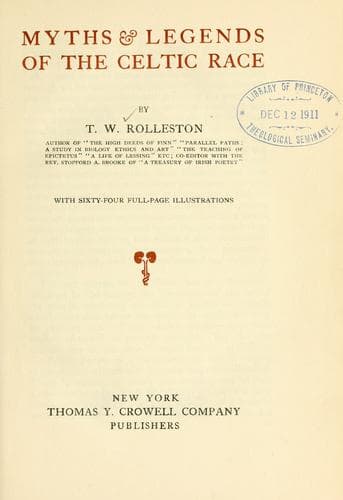
Myths & Legends of the Celtic RaceRolleston, T. W. (Thomas William)
Religion
Myths & Legends of the Celtic Race
Rolleston, T. W. (Thomas William)
Celts -- Religion; Mythology, Celtic
Irish mythical and legendary literature, as we have it in the most ancient
form, may be said to fall into four main divisions, and to these we shall
adhere in our presentation of it in this volume. They are, in
chronological order, the Mythological Cycle, or Cycle of the Invasions,
the Ultonian or Conorian Cycle, the Ossianic or Fenian Cycle, and a
multitude of miscellaneous tales and legends which it is hard to fit into
any historical framework.
*The Mythological Cycle*
The Mythological Cycle comprises the following sections:
1. The coming of Partholan into Ireland.
2. The coming of Nemed into Ireland.
3. The coming of the Firbolgs into Ireland.
4. The invasion of the _Tuatha De Danann_, or People of the god Dana.
5. The invasion of the Milesians (Sons of Miled) from Spain, and their
conquest of the People of Dana.
With the Milesians we begin to come into something resembling history—they
represent, in Irish legend, the Celtic race; and from them the ruling
families of Ireland are supposed to be descended. The People of Dana are
evidently gods. The pre-Danaan settlers or invaders are huge phantom-like
figures, which loom vaguely through the mists of tradition, and have
little definite characterisation. The accounts which are given of them are
many and conflicting, and out of these we can only give here the more
ancient narratives.
*The Coming of Partholan*
The Celts, as we have learned from Caesar, believed themselves to be
descended from the God of the Underworld, the God of the Dead. Partholan
is said to have come into Ireland from the West, where beyond the vast,
unsailed Atlantic Ocean the Irish Fairyland, the Land of the
Living—_i.e._, the land of the Happy Dead— was placed. His father’s name
was Sera (? the West). He came with his queen Dalny(74) and a number of
companions of both sexes. Ireland—and this is an imaginative touch
intended to suggest extreme antiquity—was then a different country,
physically, from what it is now. There were then but three lakes in
Ireland, nine rivers, and only one plain. Others were added gradually
during the reign of the Partholanians. One, Lake Rury, was said to have
burst out as a grave was being dug for Rury, son of Partholan.
*The Fomorians*
The Partholanians, it is said, had to do battle with a strange race,
called the Fomorians, of whom we shall hear much in later sections of this
book. They were a huge, misshapen, violent and cruel people, representing,
we may believe, the powers of evil. One of these was surnamed _Cenchos_,
which means The Footless, and thus appears to be related to Vitra, the God
of Evil in Vedantic mythology, who had neither feet nor hands. With a host
of these demons Partholan fought for the lordship of Ireland, and drove
them out to the northern seas, whence they occasionally harried the
country under its later rulers.
Public-domain text, read in full here on John Shaqi.
Reviews
Reviews
No reviews yet
Be the first to share your thoughts on this work.
Join the Discussion
Join the discussion
Sign in to leave a comment or review.
Sign InorCreate an account