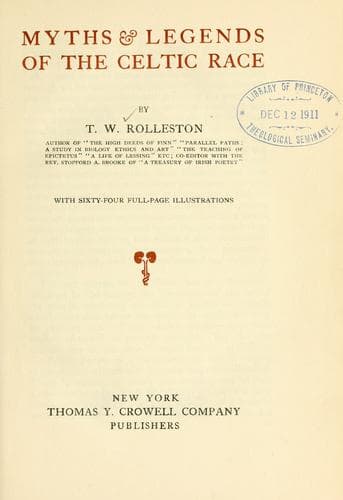
Myths & Legends of the Celtic RaceRolleston, T. W. (Thomas William)
Religion
Myths & Legends of the Celtic Race
Rolleston, T. W. (Thomas William)
Celts -- Religion; Mythology, Celtic
The end of the race of Partholan was that they were afflicted by
pestilence, and having gathered together on the Old Plain (Senmag) for
convenience of burying their dead, they all perished there; and Ireland
once more lay empty for reoccupation.
*The Legend of Tuan mac Carell*
Who, then, told the tale? This brings us to the mention of a very curious
and interesting legend—one of the numerous legendary narratives in which
these tales of the Mythical Period have come down to us. It is found in
the so-called “Book of the Dun Cow,” a manuscript of about the year A.D.
1100, and is entitled “The Legend of Tuan mac Carell.”
St. Finnen, an Irish abbot of the sixth century, is said to have gone to
seek hospitality from a chief named Tuan mac Carell, who dwelt not far
from Finnen’s monastery at Moville, Co. Donegal. Tuan refused him
admittance. The saint sat down on the doorstep of the chief and fasted for
a whole Sunday,(75) upon which the surly pagan warrior opened the door to
him. Good relations were established between them, and the saint returned
to his monks.
“Tuan is an excellent man,” said he to them; “he will come to you and
comfort you, and tell you the old stories of Ireland.”(76)
This humane interest in the old myths and legends of the country is, it
may here be observed, a feature as constant as it is pleasant in the
literature of early Irish Christianity.
Tuan came shortly afterwards to return the visit of the saint, and invited
him and his disciples to his fortress. They asked him of his name and
lineage, and he gave an astounding reply. “I am a man of Ulster,” he said.
“My name is Tuan son of Carell. But once I was called Tuan son of Starn,
son of Sera, and my father, Starn, was the brother of Partholan.”
“Tell us the history of Ireland,” then said Finnen, and Tuan began.
Partholan, he said, was the first of men to settle in Ireland. After the
great pestilence already narrated he alone survived, “for there is never a
slaughter that one man does not come out of it to tell the tale.” Tuan was
alone in the land, and he wandered about from one vacant fortress to
another, from rock to rock, seeking shelter from the wolves. For
twenty-two years he lived thus alone, dwelling in waste places, till at
last he fell into extreme decrepitude and old age.
“Then Nemed son of Agnoman took possession of Ireland. He
[Agnoman] was my father’s brother. I saw him from the cliffs, and
kept avoiding him. I was long-haired, clawed, decrepit, grey,
naked, wretched, miserable. Then one evening I fell asleep, and
when I woke again on the morrow I was changed into a stag. I was
young again and glad of heart. Then I sang of the coming of Nemed
and of his race, and of my own transformation.... ‘I have put on a
new form, a skin rough and grey. Victory and joy are easy to me; a
little while ago I was weak and defenceless.’ ”
Tuan is then king of all the deer of Ireland, and so remained all the days
of Nemed and his race.
Public-domain text, read in full here on John Shaqi.
Reviews
Reviews
No reviews yet
Be the first to share your thoughts on this work.
Elsewhere in the archive
Join the Discussion
Join the discussion
Sign in to leave a comment or review.
Sign InorCreate an account