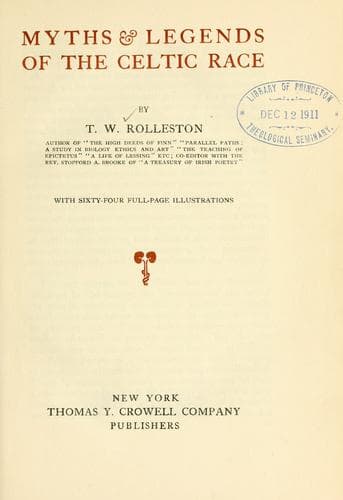
Myths & Legends of the Celtic RaceRolleston, T. W. (Thomas William)
Religion
Myths & Legends of the Celtic Race
Rolleston, T. W. (Thomas William)
Celts -- Religion; Mythology, Celtic
splendour and exaltation appears to invest the People of Dana, recalling
the high estate from which they had been dethroned.
*The Popular and the Bardic Conceptions*
Nor must it be overlooked that the popular conception of the Danaan
deities was probably at all times something different from the bardic and
Druidic, or in other words the scholarly, conception. The latter, as we
shall see, represents them as the presiding deities of science and poetry.
This is not a popular idea; it is the product of the Celtic, the Aryan
imagination, inspired by a strictly intellectual conception. The common
people, who represented mainly the Megalithic element in the population,
appear to have conceived their deities as earth-powers—_dei terreni_, as
they are explicitly called in the eighth-century “Book of
Armagh”(80)—presiding, not over science and poetry, but rather
agriculture, controlling the fecundity of the earth and water, and
dwelling in hills, rivers, and lakes. In the bardic literature the Aryan
idea is prominent; the other is to be found in innumerable folk-tales and
popular observances; but of course in each case a considerable amount of
interpenetration of the two conceptions is to be met with—no sharp
dividing line was drawn between them in ancient times, and none can be
drawn now.
*The Treasures of the Danaans*
Tuan mac Carell says they came to Ireland “out of heaven.” This is
embroidered in later tradition into a narrative telling how they sprang
from four great cities, whose very names breathe of fairydom and
romance—Falias, Gorias, Finias, and Murias. Here they learned science and
craftsmanship from great sages one of whom was enthroned in each city, and
from each they brought with them a magical treasure. From Falias came the
stone called the _Lia Fail_, or Stone of Destiny, on which the High-Kings
of Ireland stood when they were crowned, and which was supposed to confirm
the election of a rightful monarch by roaring under him as he took his
place on it. The actual stone which was so used at the inauguration of a
reign did from immemorial times exist at Tara, and was sent thence to
Scotland early in the sixth century for the crowning of Fergus the Great,
son of Erc, who begged his brother Murtagh mac Erc, King of Ireland, for
the loan of it. An ancient prophecy told that wherever this stone was, a
king of the Scotic (_i.e._, Irish-Milesian) race should reign. This is the
famous Stone of Scone, which never came back to Ireland, but was removed
to England by Edward I. in 1297, and is now the Coronation Stone in
Westminster Abbey. Nor has the old prophecy been falsified, since through
the Stuarts and Fergus mac Erc the descent of the British royal family can
be traced from the historic kings of Milesian Ireland.
Public-domain text, read in full here on John Shaqi.
Reviews
Reviews
No reviews yet
Be the first to share your thoughts on this work.
Elsewhere in the archive
Join the Discussion
Join the discussion
Sign in to leave a comment or review.
Sign InorCreate an account