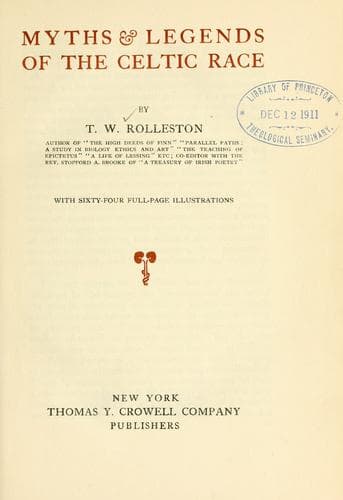
Myths & Legends of the Celtic RaceRolleston, T. W. (Thomas William)
Religion
Myths & Legends of the Celtic Race
Rolleston, T. W. (Thomas William)
Celts -- Religion; Mythology, Celtic
Who were the Firbolgs, and what did they represent in Irish legend? The
name appears to mean “Men of the Bags,” and a legend was in later times
invented to account for it. It was said that after settling in Greece they
were oppressed by the people of that country, who set them to carry earth
from the fertile valleys up to the rocky hills, so as to make arable
ground of the latter. They did their task by means of leathern bags; but
at last, growing weary of the oppression, they made boats or coracles out
of their bags, and set sail in them for Ireland. Nennius, however, says
they came from Spain, for according to him all the various races that
inhabited Ireland came originally from Spain; and “Spain” with him is a
rationalistic rendering of the Celtic words designating the Land of the
Dead.(77) They came in three groups, the Fir-Bolg, the Fir-Domnan, and the
Galioin, who are all generally designated as Firbolgs. They play no great
part in Irish mythical history, and a certain character of servility and
inferiority appears to attach to them throughout.
One of their kings, Eochy(78) mac Erc, took in marriage Taltiu, or Telta,
daughter of the King of the “Great Plain” (the Land of the Dead). Telta
had a palace at the place now called after her, Telltown (properly
Teltin). There she died, and there, even in mediæval Ireland, a great
annual assembly or fair was held in her honour.
*The Coming of the People of Dana*
We now come to by far the most interesting and important of the mythical
invaders and colonisers of Ireland, the People of Dana. The name, _Tuatha
De Danann_, means literally “the folk of the god whose mother is Dana.”
Dana also sometimes bears another name, that of Brigit, a goddess held in
much honour by pagan Ireland, whose attributes are in a great measure
transferred in legend to the Christian St. Brigit of the sixth century.
Her name is also found in Gaulish inscriptions as “Brigindo,” and occurs
in several British inscriptions as “Brigantia.” She was the daughter of
the supreme head of the People of Dana, the god Dagda, “The Good.” She had
three sons, who are said to have had in common one only son, named
Ecne—that is to say, “Knowledge,” or “Poetry.”(79) Ecne, then, may be said
to be the god whose mother was Dana, and the race to whom she gave her
name are the clearest representatives we have in Irish myths of the powers
of Light and Knowledge. It will be remembered that alone among all these
mythical races Tuan mac Carell gave to the People of Dana the name of
“gods.” Yet it is not as gods that they appear in the form in which Irish
legends about them have now come down to us. Christian influences reduced
them to the rank of fairies or identified them with the fallen angels.
They were conquered by the Milesians, who are conceived as an entirely
human race, and who had all sorts of relations of love and war with them
until quite recent times. Yet even in the later legends a certain
Public-domain text, read in full here on John Shaqi.
Reviews
Reviews
No reviews yet
Be the first to share your thoughts on this work.
Elsewhere in the archive
Join the Discussion
Join the discussion
Sign in to leave a comment or review.
Sign InorCreate an account