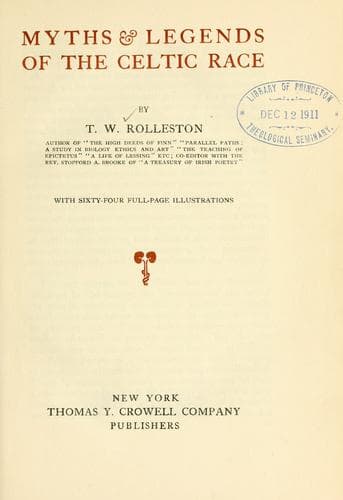
Myths & Legends of the Celtic RaceRolleston, T. W. (Thomas William)
Religion
Myths & Legends of the Celtic Race
Rolleston, T. W. (Thomas William)
Celts -- Religion; Mythology, Celtic
When the Dagda got possession of the harp, the tale goes on, he played on
it the “three noble strains” which every great master of the harp should
command, namely, the Strain of Lament, which caused the hearers to weep,
the Strain of Laughter, which made them merry, and the Strain of Slumber,
or Lullaby, which plunged them all in a profound sleep. And under cover of
that sleep the Danaan champion stole out and escaped. It may be observed
that throughout the whole of the legendary literature of Ireland skill in
music, the art whose influence most resembles that of a mysterious spell
or gift of Faëry, is the prerogative of the People of Dana and their
descendants. Thus in the “Colloquy of the Ancients,” a collection of tales
made about the thirteenth or fourteenth century, St. Patrick is introduced
to a minstrel, Cascorach, “a handsome, curly-headed, dark-browed youth,”
who plays so sweet a strain that the saint and his retinue all fall
asleep. Cascorach, we are told, was son of a minstrel of the Danaan folk.
St. Patrick’s scribe, Brogan, remarks, “A good cast of thine art is that
thou gavest us.” “Good indeed it were,” said Patrick, “but for a twang of
the fairy spell that infests it; barring which nothing could more nearly
resemble heaven’s harmony.”(89) Some of the most beautiful of the antique
Irish folk-melodies,—_e.g._, the _Coulin_—are traditionally supposed to
have been overheard by mortal harpers at the revels of the Fairy Folk.
*Names and Characteristics of the Danaan Deities*
I may conclude this narrative of the Danaan conquest with some account of
the principal Danaan gods and their attributes, which will be useful to
readers of the subsequent pages. The best with which I am acquainted is to
be found in Mr. Standish O’Grady’s “Critical History of Ireland.”(90) This
work is no less remarkable for its critical insight—it was published in
1881, when scientific study of the Celtic mythology was little heard
of—than for the true bardic imagination, kindred to that of the ancient
myth-makers themselves, which recreates the dead forms of the past and
dilates them with the breath of life. The broad outlines in which Mr.
O’Grady has laid down the typical characteristics of the chief personages
in the Danaan cycle hardly need any correction at this day, and have been
of much use to me in the following summary of the subject.
*The Dagda*
Public-domain text, read in full here on John Shaqi.
Reviews
Reviews
No reviews yet
Be the first to share your thoughts on this work.
Elsewhere in the archive
Join the Discussion
Join the discussion
Sign in to leave a comment or review.
Sign InorCreate an account