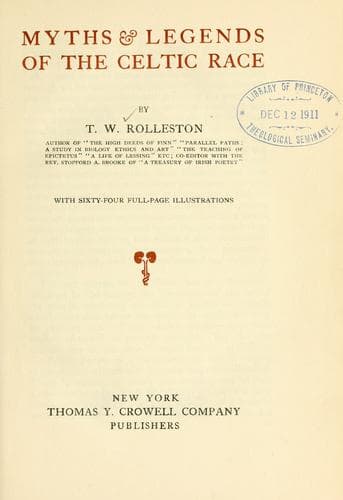
Myths & Legends of the Celtic RaceRolleston, T. W. (Thomas William)
Religion
Myths & Legends of the Celtic Race
Rolleston, T. W. (Thomas William)
Celts -- Religion; Mythology, Celtic
“One stroke of the oar, one hour’s voyage at most, suffices for the
midnight journey which transfers the Dead from the Gaulish continent to
their final abode. Some mysterious law, indeed, brings together in the
night the great spaces which divide the domain of the living from that of
the dead in daytime. It was the same law which enabled Ith one fine winter
evening to perceive from the Tower of Bregon, in the Land of the Dead, the
shores of Ireland, or the land of the living. The phenomenon took place in
winter; for winter is a sort of night; winter, like night, lowers the
barriers between the regions of Death and those of Life; like night,
winter gives to life the semblance of death, and suppresses, as it were,
the dread abyss that lies between the two.”
At this time, it is said, Ireland was ruled by three Danaan kings,
grandsons of the Dagda. Their names were MacCuill, MacCecht, and MacGrené,
and their wives were named respectively Banba, Fohla, and Eriu. The Celtic
habit of conceiving divine persons in triads is here illustrated. These
triads represent one person each, and the mythical character of that
personage is evident from the name of one of them, MacGrené, Son of the
Sun. The names of the three goddesses have each at different times been
applied to Ireland, but that of the third, Eriu, has alone persisted, and
in the dative form, Erinn, is a poetic name for the country to this day.
That Eriu is the wife of MacGrené means, as de Jubainville observes, that
the Sun-god, the god of Day, Life, and Science, has wedded the land and is
reigning over it.
Ith, on landing, finds that the Danaan king, Neit, has just been slain in
a battle with the Fomorians, and the three sons, MacCuill and the others,
are at the fortress of Aileach, in Co. Donegal, arranging for a division
of the land among themselves. At first they welcome Ith, and ask him to
settle their inheritance. Ith gives his judgment, but, in concluding, his
admiration for the newly discovered country breaks out: “Act,” he says,
“according to the laws of justice, for the country you dwell in is a good
one, it is rich in fruit and honey, in wheat and in fish; and in heat and
cold it is temperate.” From this panegyric the Danaans conclude that 1th
has designs upon their land, and they seize him and put him to death. His
companions, however, recover his body and bear it back with them in their
ships to “Spain”; when the children of Miled resolve to take vengeance for
the outrage and prepare to invade Ireland.
Public-domain text, read in full here on John Shaqi.
Reviews
Reviews
No reviews yet
Be the first to share your thoughts on this work.
Elsewhere in the archive
Join the Discussion
Join the discussion
Sign in to leave a comment or review.
Sign InorCreate an account