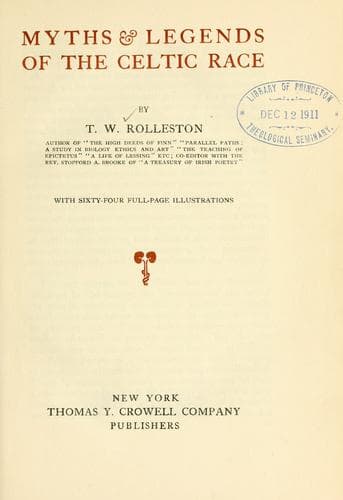
Myths & Legends of the Celtic RaceRolleston, T. W. (Thomas William)
Religion
Myths & Legends of the Celtic Race
Rolleston, T. W. (Thomas William)
Celts -- Religion; Mythology, Celtic
“O fair-haired woman, will you come with me to the marvellous land, full
of music, where the hair is primrose-yellow and the body white
as snow?
There none speaks of ‘mine’ or ‘thine’—white are the teeth and black the
brows; eyes flash with many-coloured lights, and the hue of
the foxglove is on every cheek.
Pleasant to the eye are the plains of Erin, but they are a desert to the
Great Plain.
Heady is the ale of Erin, but the ale of the Great Plain is headier.
It is one of the wonders of that land that youth does not change into age.
Smooth and sweet are the streams that flow through it; mead and wine
abound of every kind; there men are all fair, without blemish;
there women conceive without sin.
We see around us on every side, yet no man seeth us; the cloud of the sin
of Adam hides us from their observation.
“O lady, if thou wilt come to my strong people, the purest of gold shall
be on thy head—thy meat shall be swine’s flesh unsalted,(126)
new milk and mead shall thou drink with me there, O
fair-haired woman.
I have given this remarkable lyric at length because, though Christian and
ascetic ideas are obviously discernible in it, it represents on the whole
the pagan and mythical conception of the Land of Youth, the country of the
Dead.
Etain, however, is by no means ready to go away with a stranger and to
desert the High King for a man “without name or lineage.” Midir tells her
who he is, and all her own history of which, in her present incarnation,
she knows nothing; and he adds that it was one thousand and twelve years
from Etain’s birth in the Land of Youth till she was born a mortal child
to the wife of Etar. Ultimately Etain agrees to return with Midir to her
ancient home, but only on condition that the king will agree to their
severance, and with this Midir has to be content for the time.
*A Game of Chess*
Shortly afterwards he appears to King Eochy, as already related,(127) on
the Hill of Tara. He tells the king that he has come to play a game of
chess with him, and produces a chessboard of silver with pieces of gold
studded with jewels. To be a skilful chess-player was a necessary
accomplishment of kings and nobles in Ireland, and Eochy enters into the
game with zest. Midir allows him to win game after game, and in payment
for his losses he performs by magic all kinds of tasks for Eochy,
reclaiming land, clearing forests, and building causeways across bogs—here
we have a touch of the popular conception of the Danaans as earth deities
associated with agriculture and fertility. At last, having excited Eochy’s
cupidity and made him believe himself the better player, he proposes a
final game, the stakes to be at the pleasure of the victor after the game
is over. Eochy is now defeated.
“My stake is forfeit to thee,” said Eochy.
“Had I wished it, it had been forfeit long ago,” said Midir.
Public-domain text, read in full here on John Shaqi.
Reviews
Reviews
No reviews yet
Be the first to share your thoughts on this work.
Elsewhere in the archive
Join the Discussion
Join the discussion
Sign in to leave a comment or review.
Sign InorCreate an account