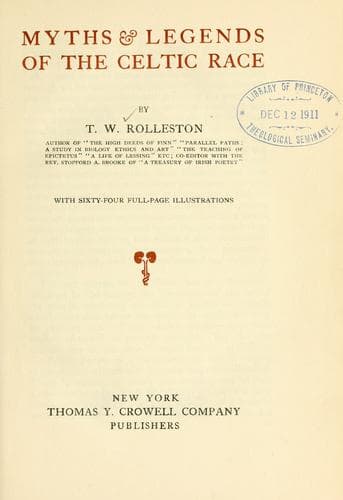
Myths & Legends of the Celtic RaceRolleston, T. W. (Thomas William)
Religion
Myths & Legends of the Celtic Race
Rolleston, T. W. (Thomas William)
Celts -- Religion; Mythology, Celtic
From this Etain ultimately sprang the great king Conary Mōr, who shines in
Irish legend as the supreme type of royal splendour, power, and
beneficence, and whose overthrow and death were compassed by the Danaans
in vengeance for the devastation of their sacred dwellings by Eochy. The
tale in which the death of Conary is related is one of the most antique
and barbaric in conception of all Irish legends, but it has a magnificence
of imagination which no other can rival. To this great story the tale of
Etain and Midir may be regarded as what the Irish called a _priomscel_,
“introductory tale,” showing the more remote origin of the events related.
The genealogy of Conary Mōr will help the reader to understand the
connexion of events.
Eochy=Etain.
|
Cormac, King=Etain Oig (Etain the younger).
of Ulster. |
|
Eterskel, King=Messbuachalla (the cowherd’s fosterling).
of Erin. |
|
Conary Mōr.
*The Law of the Geis*
The tale of Conary introduces us for the first time to the law or
institution of the _geis_, which plays henceforward a very important part
in Irish legend, the violation or observance of a _geis_ being frequently
the turning-point in a tragic narrative. We must therefore delay a moment
to explain to the reader exactly what this peculiar institution was.
Dineen’s “Irish Dictionary” explains the word _geis_ (pronounced
“gaysh”—plural, “gaysha”) as meaning “a bond, a spell, a prohibition, a
taboo, a magical injunction, the violation of which led to misfortune and
death.”(128) Every Irish chieftain or personage of note had certain
_geise_ peculiar to himself which he must not transgress. These _geise_
had sometimes reference to a code of chivalry—thus Dermot of the
Love-spot, when appealed to by Grania to take her away from Finn, is under
_geise_ not to refuse protection to a woman. Or they may be merely
superstitious or fantastic—thus Conary, as one of his _geise_, is
forbidden to follow three red horsemen on a road, nor must he kill birds
(this is because, as we shall see, his totem was a bird). It is a _geis_
to the Ulster champion, Fergus mac Roy, that he must not refuse an
invitation to a feast; on this turns the Tragedy of the Sons of Usnach. It
is not at all clear who imposed these _geise_ or how any one found out
what his personal _geise_ were—all that was doubtless an affair of the
Druids. But they were regarded as sacred obligations, and the worst
misfortunes were to be apprehended from breaking them. Originally, no
doubt, they were regarded as a means of keeping oneself in proper
relations with the other world—the world of Faëry—and were akin to the
well-known Polynesian practice of the “tabu.” I prefer, however, to retain
the Irish word as the only fitting one for the Irish practice.
*The Cowherd’s Fosterling*
Public-domain text, read in full here on John Shaqi.
Reviews
Reviews
No reviews yet
Be the first to share your thoughts on this work.
Elsewhere in the archive
Join the Discussion
Join the discussion
Sign in to leave a comment or review.
Sign InorCreate an account