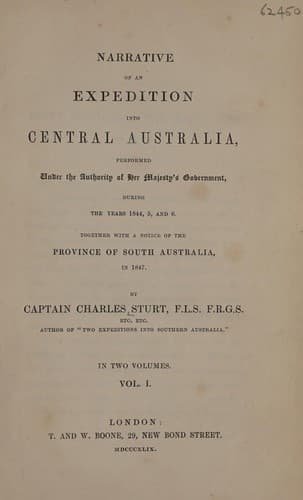
Narrative of an Expedition into Central Australia: Performed Under the Authority of Her Majesty's Government, During the Years 1844, 5, and 6, Together With A Notice of the Province of South Australia in 1847Sturt, Charles
History
Narrative of an Expedition into Central Australia: Performed Under the Authority of Her Majesty's Government, During the Years 1844, 5, and 6, Together With A Notice of the Province of South Australia in 1847
Sturt, Charles
Central Australia -- Discovery and exploration; Natural history -- Australia -- Central Australia; South Australia -- Description and travel
The ground whereon we now travelled was hard and firm, so that we
progressed rapidly, and at five miles descended into a bare flat of
whitish clay, on which a few bushes of polygonum were alone growing under
box-trees. At about two hundred yards we were stopped by a watercourse,
into which the floods of the Darling were flowing with great velocity. It
was about fifty yards broad, had low muddy banks, and was decidedly the
poorest spot we had seen of the kind. This, Nadbuck informed me, was the
Williorara or Laidley's Ponds, a piece of intelligence at which I was
utterly confounded. I could not but reproach both him and Toonda for
having so deceived me; but the latter said he had been away a long time
and that there was plenty of grass when he left. Nadbuck, on the other
hand, said he derived his information from others, and only told me what
they told him. Be that as it may, it was impossible for me to remain in
such a place, and I therefore turned back towards the Darling, and
pitched my tents at its junction with the Williorara.
For three or four days prior to our arrival at Laidley's Ponds, the
upward course of the river had been somewhat to the west of north. The
course of Laidley's Ponds was exceedingly tortuous, but almost due west.
The natives explained to us that it served as a channel of communication
between two lakes that were on either side of it, called Minandichi and
Cawndilla. They stated that the former extended between the Darling and
the ranges, but that Cawndilla was to the westward at the termination of
Laidley's Ponds, by means of which it is filled with water every time the
Darling rose; but they assured me that the waters had not yet reached the
lake. It was nevertheless evident that we were in an angle, and our
position was anything but a favourable one. From the point where we had
now arrived the upward course of the Darling for 300 miles is to the
N.E., that which I was anxious to take, was to the W.N.W. It was evident,
therefore, that until every attempt to penetrate the interior in that
direction had proved impracticable, I should not have been justified in
pushing farther up the river. My hopes of finding the Williorara a
mountain stream had been wholly disappointed, and the intelligence both
Mr. Eyre and I had received of it from the Murray natives had turned out
to be false, for instead of finding it a medium by which to gain the
hills, I now ascertained that it had not a course of more than nine or
ten miles, and that it stood directly in my way. We were as yet ignorant
what the conduct of the natives towards us would be, having seen none or
very few who could have taken part in the dispute between Sir Thomas
Mitchell and the Williorara tribe in 1836. Expecting that they might be
hostilely disposed towards us, I hesitated leaving the camp, lest any
rupture should take place between my men and the natives during my
absence; much less could I think of fortifying the party in a position
Reviews
Reviews
No reviews yet
Be the first to share your thoughts on this work.
Elsewhere in the archive
Join the Discussion
Join the discussion
Sign in to leave a comment or review.
Sign InorCreate an account