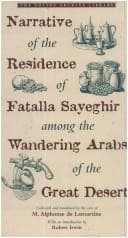
Narrative of the residence of Fatalla Sayeghir among the wandering Arabs of the great desertLamartine, Alphonse de
History
Narrative of the residence of Fatalla Sayeghir among the wandering Arabs of the great desert
Lamartine, Alphonse de
Arabian Peninsula -- Description and travel
“We, Abdallah, son of Abdel Aziz, son of Abdel Wahabs, son of Sihoud:
We give you to know, O son of Chahllan, (may the only adorable God
direct you in the right way!) that if you believe in God, you must obey
his slave Abdallah, to whom he has delegated his power, and come and
see us without fear. You shall be our well-beloved son; we will pardon
the past, and treat you as one of ourselves. But beware of obstinacy
and resistance to our call; for he who listens to us is reckoned in the
number of the inhabitants of paradise.
“Health.
“Signed,
El Manhoud Menalla Ebn Sihoud Abdallah.”
On the reception of this letter we held a great council of war; and
after having deliberately weighed all the perils of the journey against
the advantages of the alliance of Ebn Sihoud, the Drayhy determined to
comply with this authoritative invitation. Sheik Ibrahim having asked
me if I felt my courage equal to undertaking a visit to this fanatic, I
replied:
“I am well aware that my risk is greater than that of others, on
account of his hatred of all Christians; but I put my confidence in
God. I must die once, and having already made a sacrifice of my life, I
am willing to undertake any task likely to promote the entire execution
of the enterprise upon which I have entered.”
A desire of seeing this extraordinary man and his curious country also
excited my courage, and having earnestly recommended my poor mother
to the protection of M. Lascaris, if I should die in this expedition,
I set out with the Drayhy, his second son Sahdoun, his nephew, his
cousin, two of the principal chiefs, and five negroes, all mounted on
dromedaries. During his father’s absence, Saher was to command the
tribe, and conduct it to Horran, to meet the Drayhy, who proposed
returning by the Hegiaz. We made our first halt among the Bedouins
Beny Toulab, whose sole wealth consists in a few asses, and who live
by hunting gazelles and ostriches. They wear the skins of gazelles
coarsely sewed together, forming long robes with very large sleeves;
and the fur being outside, their appearance much resembles that of
wild beasts: I have never seen anything so savage as their aspect.
They showed us an ostrich hunt, in which I was greatly interested.
The female ostrich lays her eggs in the sand, and takes up her station
at some distance, looking fixedly upon them: she covers them as it
were, with her eyes, which she never turns from the nest. She remains
thus immovable for half the day, until the male comes to relieve her.
She then goes in search of food whilst her mate keeps guard in his
turn. The hunter, when he has discovered the eggs, constructs a sort
of shed with stones to conceal himself, and waits behind it for the
favourable moment. When the female is left alone, and the male at a
sufficient distance to prevent his taking alarm at the report, he draws
his trigger, runs to pick up the unfortunate bird who has received her
Public-domain text, read in full here on John Shaqi.
Reviews
Reviews
No reviews yet
Be the first to share your thoughts on this work.
Elsewhere in the archive
Join the Discussion
Join the discussion
Sign in to leave a comment or review.
Sign InorCreate an account