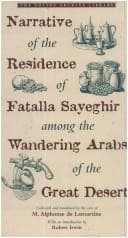
Narrative of the residence of Fatalla Sayeghir among the wandering Arabs of the great desertLamartine, Alphonse de
History
Narrative of the residence of Fatalla Sayeghir among the wandering Arabs of the great desert
Lamartine, Alphonse de
Arabian Peninsula -- Description and travel
However, as the autumn was now come, we commenced our return towards
the east. As we approached Homs, the governor sent the Drayhy forty
camels loaded with corn, ten machlas, and a pelisse of honour. Sheik
Ibrahim addressed me in private and said, “We are going into the
desert; we have exhausted all our stock; what must we do?” “Give me
your orders,” I replied; “I will go secretly to Aleppo, and get what we
want, and I will engage not to make myself known to my family.” It was
agreed that I should rejoin the tribe at Zour; and I went to Aleppo.
I took up my station in a khan but little frequented, and remote from
all my acquaintances. I sent a stranger to the correspondent of M.
Lascaris to get five hundred tallaris. The precaution was unnecessary,
for with my long beard, my costume, and my Bedouin accent, I ran no
risk of being known; I proved this sufficiently on purchasing some
goods at the Bazaar. I met many of my friends there, and amused
myself with behaving rudely to them. But to these moments of careless
gaiety, painful ones succeeded; I passed and repassed continually
before the door of my house, hoping to get a glimpse of my brother or
my poor mother. My desire of seeing her above all was so great that I
was twenty times on the point of breaking my word; but the conviction
that she would not again allow me to return to M. Lascaris restored
my courage, and after six days I was obliged to tear myself away from
Aleppo, without obtaining any news of my relatives.
I overtook the tribe on the banks of the Euphrates opposite
Daival-Chahar, where there are still some fine ruins of an ancient
city. I found the Bedouins engaged, before crossing the river, in
selling cattle, or changing them for goods with the pedlers from
Aleppo. They have no idea of the value of fictitious money; they will
not receive gold in payment, recognising nothing but silver tallaris.
They would rather pay too much, or not receive enough in change, than
admit of fractions. The merchants, aware of this foible, dexterously
profit by it. Besides the exchanges, the tribes sold to the amount of
twenty-five thousand tallaris; and every man put his money into his
sack of flour, that it might not sound on loading and unloading.
Public-domain text, read in full here on John Shaqi.
Reviews
Reviews
No reviews yet
Be the first to share your thoughts on this work.
Elsewhere in the archive
Join the Discussion
Join the discussion
Sign in to leave a comment or review.
Sign InorCreate an account