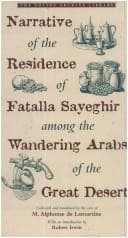
Narrative of the residence of Fatalla Sayeghir among the wandering Arabs of the great desertLamartine, Alphonse de
History
Narrative of the residence of Fatalla Sayeghir among the wandering Arabs of the great desert
Lamartine, Alphonse de
Arabian Peninsula -- Description and travel
The next morning I again took the road to Corietain, where I waited
for twenty days the return of the messenger I had sent to Aleppo,--a
respite which I found very seasonable both for repose and for the
repair of my tattered wardrobe; but necessity protracted my stay beyond
my inclination, for news was spread that the Wahabees had invaded
the desert of Damascus and ravaged several villages, massacreing men
and children without exception, and pillaging the women, whom alone
they spared. The Sheik of Corietain, too weak to offer the smallest
resistance, caused the gates of the town to be closed, forbade any
egress from it, and tremblingly awaited the issue. We soon learned
that the enemy having attacked Palmyra, the inhabitants had retired
within the precincts of the temple, and there successfully defended
themselves; and that the Wahabees, unable to force their position,
had contented themselves with killing the camel drivers and carrying
off their camels. From thence they proceeded to ransack the village
of Arack, and had dispersed themselves throughout the environs. This
sinister intelligence alarmed me for the fate of my messenger, who
however arrived safe and sound with Sheik Ibrahim’s money. He had taken
refuge for a short time at Saddad, the inhabitants of which having paid
a pretty heavy contribution, had for the moment nothing more to fear.
Profiting by this circumstance, I laid aside my Bedouin habiliments,
and dressing myself as a Christian of Saddad, made my way to that
village, where I obtained news of the Drayhy, who was encamped with the
tribe of Bargiass at Ghandah el Cham. I rejoined him the first possible
opportunity, and learned with chagrin that a formidable coalition had
been effected between Mehanna el Fadel and the tribe established at
Samarcand; and that by their intrigues with the governors of Hems and
Hama, some Turks and Bedouins had been drawn into the alliance against
us. In this critical conjuncture I bethought myself of our friend the
Pacha Soliman, and persuaded Sheik Ibrahim to visit Damascus for the
purpose of consulting with him. We set out at once, and alighted at
the house of his prime minister, Hagim, from whom we learned the name
of the supposed English princess: he informed us that it was through
the influence of Lady Stanhope’s presents that Mehanna had acquired
so powerful a party amongst the Turks. These details confirmed our
suspicions that England, aware of our projects, was subsidizing the
Wahabees on one hand, while on the other she endeavoured, through
the intervention of Lady Stanhope, to unite the Bedouins of Syria
with the Turks. An Englishman, whom we met at the house of M.
Chabassan, assuming the name of Sheik Ibrahim, added strength to these
conjectures: he endeavoured to extract something from us, but we were
too much upon our guard. Having obtained what we wished from Soliman
Pacha, we hastened to rejoin our tribe.
Public-domain text, read in full here on John Shaqi.
Reviews
Reviews
No reviews yet
Be the first to share your thoughts on this work.
Elsewhere in the archive
Join the Discussion
Join the discussion
Sign in to leave a comment or review.
Sign InorCreate an account