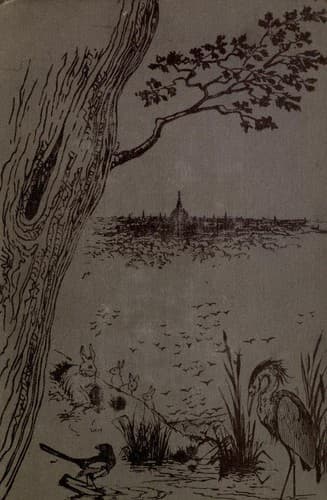
Country life -- England; Natural history -- Outdoor books; Nature study
In frosty weather, again, when the houses take hard, stern tints, when
the sky is clear over great part of its extent, but with heavy
thunderous-looking clouds in places--clouds full of snow--the sun
becomes of a red or orange hue, and reminds one of the lines of
Longfellow when Othere reached the North Cape--
"Round in a fiery ring
Went the great sun, oh King!
With red and lurid light."
The redness of the winter sun in London is, indeed, characteristic.
A sunset in winter or early spring floods the streets with fiery glow.
It comes, for instance, down Piccadilly; it is reflected from the smooth
varnished roofs of the endless carriages that roll to and fro like the
flicker of a mighty fire; it streaks the side of the street with
rosiness. The faces of those who are passing are lit up by it, all
unconscious as they are. The sky above London, indeed, is as full of
interest as above the hills. Lunar rainbows occasionally occur; two to
my knowledge were seen in the direction and apparently over the
metropolis recently.
When a few minutes on the rail has carried you outside the hub as it
were of London, among the quiet tree-skirted villas, the night reigns as
completely as in the solitudes of the country. Perhaps even more so, for
the solitude is somehow more apparent. The last theatre-goer has
disappeared inside his hall door, the last dull roll of the brougham,
with its happy laughing load, has died away--there is not so much as a
single footfall. The cropped holly hedges, the leafless birches, the
limes and acacias are still and distinct in the moonlight. A few steps
farther out on the highway the copse or plantation sleeps in utter
silence.
But the tall elms are the most striking; the length of the branches and
their height above brings them across the light, so that they stand out
even more shapely than when in leaf. The blue sky (not, of course, the
blue of day), the white moonlight, the bright stars--larger at midnight
and brilliant, in despite of the moon, which cannot overpower them in
winter as she does in summer evenings--all are as beautiful as on the
distant hills of old. By night, at least, even here, in the still
silence, Heaven has her own way.
When the oak leaves first begin to turn buff, and the first acorns drop,
the redwings arrive, and their "kuk-kuk" sound in the hedges and the
shrubberies in the gardens of suburban villas. They seem to come very
early to the neighbourhood of London, and before the time of their
appearance in other districts. The note is heard before they are seen;
the foliage of the shrubberies, still thick, though changing colour,
concealing them. Presently, when the trees are bare, with the exception
of a few oaks, they have disappeared, passing on towards the west. The
fieldfares, too, as I have previously observed, do not stay. But
missel-thrushes seem more numerous near town than in the country.
Public-domain text, read in full here on John Shaqi.
Reviews
Reviews
No reviews yet
Be the first to share your thoughts on this work.
Elsewhere in the archive
Join the Discussion
Join the discussion
Sign in to leave a comment or review.
Sign InorCreate an account