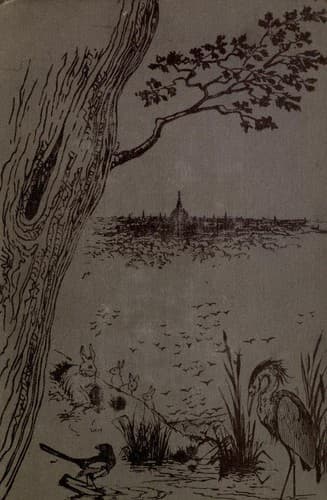
Country life -- England; Natural history -- Outdoor books; Nature study
Besides the greater beauty of English trees, shrubs, and plants, they
also attract the birds, without which the grandest plantation is a
vacancy, and another interest, too, arises from watching the progress of
their growth and the advance of the season. Our own trees and shrubs
literally keep pace with the stars which shine in our northern skies. An
astronomical floral almanack might almost be constructed, showing how,
as the constellations marched on by night, the buds and leaves and
flowers appeared by day.
The lower that brilliant Sirius sinks in the western sky after ruling
the winter heavens, and the higher that red Arcturus rises, so the buds
thicken, open, and bloom. When the Pleiades begin to rise in the early
evening, the leaves are turning colour, and the seed vessels of the
flowers take the place of the petals. The coincidences of floral and
bird life, and of these with the movements of the heavens, impart a
sense of breadth to their observation.
It is not only the violet or the anemone, there are the birds coming
from immense distances to enjoy the summer with us; there are the stars
appearing in succession, so that the most distant of objects seems
brought into connection with the nearest, and the world is made one. The
sharp distinction, the line artificially drawn between things, quite
disappears when they are thus associated.
Birds, as just remarked, are attracted by our own trees and shrubs. Oaks
are favourites with rooks and wood-pigeons; blackbirds whistle in them
in spring; if there is a pheasant about in autumn he is sure to come
under the oak; jays visit them. Elms are resorted to by most of the
larger birds. Ash plantations attract wood-pigeons and turtle-doves.
Thrushes are fond of the ash, and sing much on its boughs. The beech is
the woodpecker's tree so soon as it grows old--birch one of the
missel-thrush's.
In blackthorn the long-tailed tit builds the domed nest every one
admires. Under the cover of brambles white-throats build. Nightingales
love hawthorn, and so does every bird. Plant hawthorn, and almost every
bird will come to it, from the wood-pigeon down to the wren. Do not
clear away the fallen branches and brown leaves, sweeping the plantation
as if it were the floor of a ballroom, for it is just the tangle and the
wilderness that brings the birds, and they like the disarray.
If evergreens are wanted, there are the yew, the box, and holly--all
three well sanctioned by old custom. Thrushes will come for the yew
berries, and birds are fond of building in the thick cover of high box
hedges. Notwithstanding the prickly leaves, they slip in and out of the
holly easily. A few bunches of rushes and sedges, with some weeds and
aquatic grasses, allowed to grow about a pond, will presently bring
moorhens. Bare stones--perhaps concrete--will bring nothing.
Public-domain text, read in full here on John Shaqi.
Reviews
Reviews
No reviews yet
Be the first to share your thoughts on this work.
Elsewhere in the archive
Join the Discussion
Join the discussion
Sign in to leave a comment or review.
Sign InorCreate an account