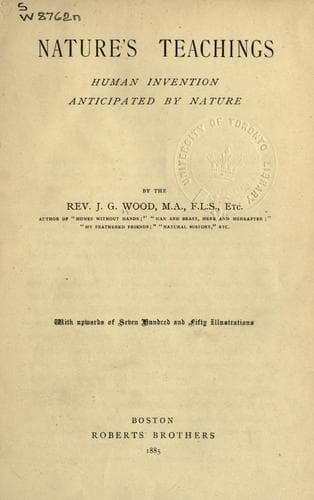
Nature's Teachings: Human Invention Anticipated by NatureWood, J. G. (John George)
History
Nature's Teachings: Human Invention Anticipated by Nature
Wood, J. G. (John George)
Inventions; Natural history
In the illustration, on the left hand, the growth of the Mangrove is
seen. The drawing is taken from a sketch by the late Mr. Baines, and
generously placed at my disposal, as were all his drawings and journals.
The Mangrove is a wet-loving tree, never flourishing unless rooted in
mud; and whether the moisture of the mud be attributable to fresh or
salt water seems to make little difference to the Mangrove, which, of
the two, appears to prefer the latter. Now, the seeds of the Mangrove
look very much like elongated skittles, except that one end comes to a
sharp point. As they hang on the tree, the point is downwards. When they
are ripe, they fall from the branch, and by their own weight are driven
deeply into the mud, where they develop roots and leaves, and become the
progenitors of the future Mangrove race.
I cannot but think that the native hunter, having seen the tremendous
force with which the Mangrove seed buries itself in the mud, has applied
the same principle to a weapon which shall bury itself in the body of an
elephant.
WAR AND HUNTING.
CHAPTER VIII.
CONCEALMENT.--DISGUISE.--THE TRENCH.--POWER OF GRAVITY.--MISCELLANEA.
Concealment needed in Modern Warfare.--Concealment by
Covering.--Masking Guns.--Birnam Wood.--The Reduvius.--The
Cuckoo-spit and the Spider-crab.--Concealment by
Disguise.--Stratagem of the Barea.--Complete Deception.--Larva of
Geometra.--The Leaf-insect.--The Luppet-moth.--The Ptarmigan and
the Ermine.--Principle of the Trench.--The Hunter’s “Skärm.”--The
Wax-moth or Galleria-moth, and its Tunnel.--Fate of a
Collection.--The Termites and the Travelling Ants of South
America.--The Power of Gravity.--The Battering-ram and its
Force.--Miscellanea.--War by Suffocation.--The Stink-pot.--The
Chili-plant.--The Sulphur-room.--The Bombardier-beetle.--The
Bullet-making Machine and the Silkworm.
CONCEALMENT.
We will first take Concealment by means of Covering.
If History repeats herself, so does Warfare. I have already shown the
repetition of History in the Fortress--I shall now show it in the Field.
In former days, when arms of precision were not invented, concealment
was not needed. No soldier ever was visited with a dream so wild as that
of taking definite aim at the enemy, and reserving the fire until the
aim was certain. I have in my collection several of the French and
English muskets used about the time of Waterloo, and, though a fair
rifle-shot, would not engage to hit a haystack with either of them at a
distance of a hundred yards. With the Snider or Martini-Henry in the
hands of a skilful adversary, he would be a bold man who would offer
himself for a target at a thousand yards. Indeed, if the first shot
happened to miss, the marksman would be tolerably sure to notice the
failure, and to correct his aim with fatal certainty.
Public-domain text, read in full here on John Shaqi.
Reviews
Reviews
No reviews yet
Be the first to share your thoughts on this work.
Elsewhere in the archive
Join the Discussion
Join the discussion
Sign in to leave a comment or review.
Sign InorCreate an account