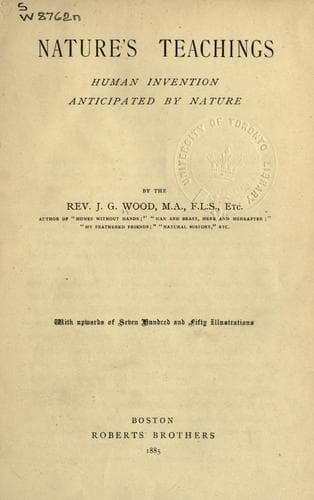
Nature's Teachings: Human Invention Anticipated by NatureWood, J. G. (John George)
History
Nature's Teachings: Human Invention Anticipated by Nature
Wood, J. G. (John George)
Inventions; Natural history
There is a certain little insect, called the Wax-moth, or Galleria-moth
(_Galleria alvearia_), which, although quite harmless in its perfect
form, is in its larval state extremely injurious to beehives.
The mother moth contrives, aided by her tiny form and sombre colouring,
to slip past the sentries at the mouth of the hive, and to lay her eggs
among the combs. This done, she dies, but the evil of her visit lives
after her.
Each of the eggs is hatched into a little caterpillar, having a soft
grey body, but a hard, horny head of a black-brown colour. As soon as
they are hatched they begin to feed, eating not only the waxen combs,
but the honey and the bee-bread which were intended for the support of
the legitimate inhabitants.
The reader may ask why the bees do not destroy this marauder on their
premises. They would be only too glad to do so, but they cannot touch
it. As it eats its way along, it constructs a strong silken tube, within
which it lives, and which it gradually lengthens. This tube or gallery
is exceedingly tough, and perfectly capable of resisting the bee’s
sting. Moreover, the caterpillar traverses its tube with such rapidity
that the bee has no chance of knowing whereabouts the caterpillar may be
when it makes its attack. When it feeds it only protrudes its armed
head, the horny covering of which is an effectual protection against the
sting.
When these creatures fairly get hold of a hive, the damage which they do
is terrible, the whole of the combs being enveloped in the
ever-increasing labyrinth of tubes. Even the bees themselves fall
victims to the Galleria-moth, for the silken tunnels are driven through
and through the combs, enveloping the broad cells as in the meshes of a
net. Consequently, when the young bees are developed, they cannot escape
from their cells, and perish miserably.
Nor do these tiresome insects confine themselves to hives; but they have
an extraordinary facility for discovering bee-combs after they are
removed from the hive. Some years ago I was making a collection of
various insect habitations, and had brought together a carefully
selected set of combs, showing the internal structure of the hive, and
the different cells which are inhabited by the worker, the drone, and
the queen bee.
One day, when about to arrange the collection in a glass case, I found
that the whole of the combs had been destroyed by the Wax-moth. Scarcely
a square inch of comb remained, and the contents of the box were little
more than a congeries of Wax-moth galleries. Even the Wasp and Hornet
nests which had been placed in the same box had been attacked, and,
although they had not been so utterly destroyed as the waxen cells, they
had been sufficiently injured to render them unfit for exhibition.
Public-domain text, read in full here on John Shaqi.
Reviews
Reviews
No reviews yet
Be the first to share your thoughts on this work.
Elsewhere in the archive
Join the Discussion
Join the discussion
Sign in to leave a comment or review.
Sign InorCreate an account