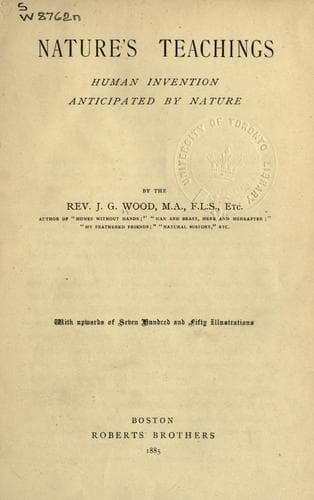
Nature's Teachings: Human Invention Anticipated by NatureWood, J. G. (John George)
History
Nature's Teachings: Human Invention Anticipated by Nature
Wood, J. G. (John George)
Inventions; Natural history
Considering the style of architecture which was then used in
fortification, namely, a combination of height with thickness, the force
of the Battering-ram would be even greater than that of artillery. The
regular and rhythmical swing of the ram would soon communicate a
vibratory motion to the wall, which would of itself tend to disintegrate
the whole structure, while the blows of the iron head beneath broke away
the stones, and rendered the downfall of the fort a mere matter of time.
The reader need hardly be reminded that the Battering-ram was so called
because its mode of attack was practically the same as that of the
animal from which it took its title.
MISCELLANEA.
By slow degrees, mankind, as they advance in civilisation, have robbed
warfare of many horrors. Non-combatants, for example, are now left
unharmed. Poisoned weapons have, by common consent, been abolished, and
so have those instruments of warfare which, though they do not simply
poison the blood by means of bodily wounds, do so by means of noxious
vapours poured into the lungs.
It is sometimes rather unfortunate when civilisation and semi-barbarism
meet in battle; the former respecting the customs of honourable warfare,
and the latter ignoring them. For example, in olden times, one of the
most potent weapons in naval combat was the “stink-pot”--_i.e._ a vessel
filled with sulphur and other ingredients, and emitting a smoke which
was death when inhaled. Among the American Indians the well-known
Chili-plant was much used for this purpose, the very first breath that
was taken of the thin and almost invisible smoke causing the throat to
contract as if clutched by a strong hand. If then any enemies had taken
refuge in a cave, or were suspected of having done so, a fire was
lighted at the entrance, a quantity of chilis thrown on it, and the rest
left to time. No being could endure that smoke and live, and they must
either stay in the cave and die, or come out and deliver themselves up
to their foes. The former was the better part to take, as suffocation,
however slow, is only an affair of a few minutes, while death by torture
is prolonged through hours.
[Illustration: Bombardier-Beetle.]
[Illustration: Chinese Stink-Pots.]
In the late Chinese war the stink-pot was extensively used, and our
sailors took it in very bad part that the enemy should be allowed to
employ such weapons, and they should be debarred from using them.
Whether this principle is still retained in the defence of fortresses I
do not know. I recollect, however, some twenty years ago, going over a
fortress in which suffocation was employed as a means of defence. A long
gallery was so placed that the assailants were tolerably sure to force
their way into it, thinking that it led to the interior of the fort.
Public-domain text, read in full here on John Shaqi.
Reviews
Reviews
No reviews yet
Be the first to share your thoughts on this work.
Elsewhere in the archive
Join the Discussion
Join the discussion
Sign in to leave a comment or review.
Sign InorCreate an account