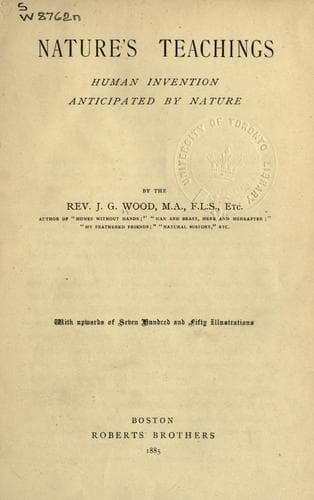
Nature's Teachings: Human Invention Anticipated by NatureWood, J. G. (John George)
History
Nature's Teachings: Human Invention Anticipated by Nature
Wood, J. G. (John George)
Inventions; Natural history
Although this information has since proved to be false, there was a
foundation of truth in it, for there really is an ape in that part of
Africa which makes huts, or rather roofs, for itself. This animal is the
Nshiego Mbouvé (_Troglodytes calvus_).
This remarkable ape has a curious way of constructing a habitation.
Choosing a horizontal branch at some distance from the ground for its
resting-place, the animal erects above it a roof composed of fresh
branches, each laid over the other in such a way that rain would shoot
off them as it does from a thatched roof. M. du Chaillu gives the
following account of this habitation:--
[Illustration: NEST OF NSHIEGO MBOUVÉ.]
[Illustration: AFRICAN TREE-HUT.]
“As we were not in haste, I bade my men cut down the trees which
contained the nests of these apes. I found them made precisely as I have
before described, and as I have always found them, of long branches and
leaves laid one over the other very carefully and thickly, so as to
render the structure capable of shedding water.
“The branches were fastened to the tree in the middle of the structure
by means of wild vines and creepers, which are so abundant in these
parts. The projecting limb on which the ape perched was about four feet
long.
“There remains no doubt that these nests are made by the animal to
protect it from the nightly rains. When the leaves begin to dry to that
degree that the structure no longer sheds water, the owner builds a new
shelter, and this happens generally once in ten or fifteen days. At this
rate the Nshiego mbouvé is an animal of no little industry.”
The roof which this ape builds is from six to eight feet in diameter,
and is tolerably circular, so that it looks something like a large
umbrella. When the animal is at rest it sits on the branch with one arm
thrown round the stem of the tree, in order to support itself during
sleep. In consequence of this attitude the hair is rubbed away on one
side, thus earning for the ape the specific title of _calvus_, or bald.
* * * * *
IT is rather remarkable that the Orang-outan of Borneo is likewise a
house-builder, though not in the same manner as the African ape which
has just been mentioned. This animal has a way of weaving together the
branches of trees, so as to make a platform on which it can repose, its
enormously powerful arms being of great service in this task. The animal
seems to make its platform in quite a mechanical manner, and it has been
noticed that when an Orang-outan has been mortally wounded, it has
expended its last energies in twisting the branches together so as to
form a couch on which it can lie down and die.
* * * * *
PUTTING aside those cases where huts have been erected in trees by way
of amusement, we may find instances where human beings have been forced
to make their habitations in trees.
Public-domain text, read in full here on John Shaqi.
Reviews
Reviews
No reviews yet
Be the first to share your thoughts on this work.
Elsewhere in the archive
Join the Discussion
Join the discussion
Sign in to leave a comment or review.
Sign InorCreate an account