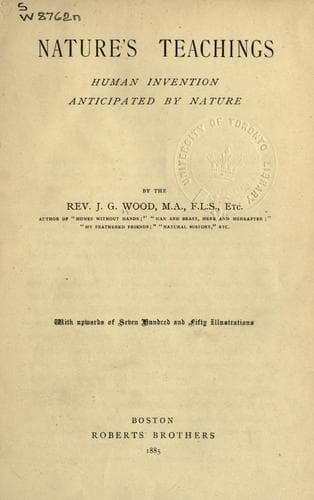
Nature's Teachings: Human Invention Anticipated by NatureWood, J. G. (John George)
History
Nature's Teachings: Human Invention Anticipated by Nature
Wood, J. G. (John George)
Inventions; Natural history
Dr. Moffat, the well-known missionary, saw one tree in which there were
no less than twenty huts. They were conical, and made of sticks and
grass, the base resting upon a platform or scaffold laid upon the fork
of a horizontal branch. The only mode of approach to these huts was by
notches cut in the trunk of the tree.
How needful were these precautions was shown by the fact that the
missionary himself spent a night in one of these aërial huts, and had
the pleasure of hearing a number of lions snarl and growl all night over
a rhinoceros hump which he had placed in an oven made of a deserted
ant-hill. The oven, however, was too hot for the lions, and they had to
retreat at daylight.
* * * * *
PASSING from the tropics to the polar regions, we now take an instance
where man has acknowledgedly copied an animal in the construction of his
dwelling.
In Esquimaux-land, where no trees can grow, where for months together
the sun never rises above the horizon, where the temperature is many
degrees below zero, and where the land and ice are alike covered with a
mantle of snow so thick that every landmark is abolished, it would seem
that no human beings could support life for one week. There is neither
timber for house-building nor wood for fuel, so that shelter, warmth,
and cookery seem to be equally impossible, and as these are among the
prime necessities of human life, it is not easy to see how mankind could
exist.
[Illustration: SNOW-HOUSE OF SEAL IN ESQUIMAUX-LAND.]
[Illustration: SNOW-HOUSE OF ESQUIMAUX.]
Yet these very regions are inhabited by sundry animals, and it is by
copying them that Man can keep his place. We have already seen how the
Esquimaux hunter copies the Polar Bear, and we have now to see how he
copies the Seal in the material and form of his dwelling-house, and not
only contrives to live, but to enjoy life all the more for the singular
conditions in which he is placed. Captain Hall mentions, in his “Life
with the Esquimaux,” that one of the natives, named Kudlago, who was
returning to his native country after visiting the United States, died
while on board the ship. Towards the end of his life he was yearning for
ice, and his last intelligible words were, “Do you see ice? Do you see
ice?”
On the vast plains of ice that are formed in the winter-time the snow
lies thickly, and yet upon such an inhospitable spot the mother seal has
to make a home for her tender young. This she does in the following
manner:--
She has already preserved a “breathing hole” in the ice, through which
she can inhale air. How she finds so small a hole under the surface of
the ice, where there are no landmarks to guide her, is a marvel to every
swimmer. She has to chase fish and follow them in all their winding
courses, and yet, when she is in want of air, is able to go straight to
her breathing hole, and there take in a fresh supply of oxygen.
Public-domain text, read in full here on John Shaqi.
Reviews
Reviews
No reviews yet
Be the first to share your thoughts on this work.
Elsewhere in the archive
Join the Discussion
Join the discussion
Sign in to leave a comment or review.
Sign InorCreate an account