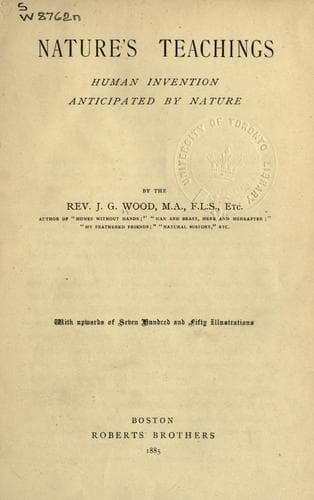
Nature's Teachings: Human Invention Anticipated by NatureWood, J. G. (John George)
History
Nature's Teachings: Human Invention Anticipated by Nature
Wood, J. G. (John George)
Inventions; Natural history
Perhaps the reader may wish to know what provision there is for
ventilation. The answer is simple enough. There is none, the Esquimaux
not requiring ventilation any more than they require washing. The two,
indeed, generally go together; and it may be observed, even in our own
country, that those who object to fresh air, and are always complaining
of draughts, have a very practical aversion to the use of fresh water,
and but little confidence in what Thackeray calls the “flimsy artifices
of the bath.”
The Esquimaux never washes, and knows not the use of linen.
Consequently, it is no matter of surprise that a sailor of Captain
Hall’s crew could not make up his mind to enter an igloo. “Whew!”
exclaimed the man, “by thunder, I’m not going in _there_! It’s crowded,
and smells horribly. How it looms up!”
Considering that there were inside that igloo a dozen Esquimaux, all
feasting on a raw, newly killed, and yet warm seal, the sailor had
reason enough to decline a visit. Captain Hall, however, determined, in
his character of explorer, to brave the strange odours, and moreover to
join the inmates in their feast, knowing that as he would have to live
among the Esquimaux for some two years, he would be forced to live as
they did, and might as well begin at once. Consequently on this resolve,
he drank the still steaming blood, and quaffed it from a cup which an
Esquimaux woman had just licked clean.
FLOORS AND PILLARS.
One decided step in Architecture is the invention of the Pillar, and its
capabilities of aiding to sustain another floor above it. We see this
principle carried out in our great cathedrals, where the use of the
Pillar is almost infinite. Take, for example, Canterbury Cathedral. A
heedless visitor might easily pass through the nave, enter the choir,
visit the various side-chapels, and “Becket’s Crown,” without thinking
that under his feet is a vast chamber, and that the floor on which he
stands is, in fact, the roof of a great crypt.
[Illustration: WASP-COMBS.]
[Illustration: SLAVE SHIP.]
The weight of the Cathedral, with its lofty towers, is so tremendous,
that the building could not be erected simply upon the ground, but rests
upon a complicated substratum of pillars and arches, whereby the weight
is spread over a large surface. In fact, the Cathedral is really two
buildings, the one erected upon the other.
* * * * *
IN Nature there are many instances of pillars supporting different
floors. One of the most beautiful examples is to be seen in the common
Cuttle-bone, as it is called, this being the internal skeleton, if it
may be so termed, of the common Sepia (_Sepia officinalis_), which is so
often found on our coasts, especially after a gale. This year (1875) I
found eight of these Cuttle-bones on the Margate sands, and all within a
space of some twelve feet square.
Public-domain text, read in full here on John Shaqi.
Reviews
Reviews
No reviews yet
Be the first to share your thoughts on this work.
Elsewhere in the archive
Join the Discussion
Join the discussion
Sign in to leave a comment or review.
Sign InorCreate an account