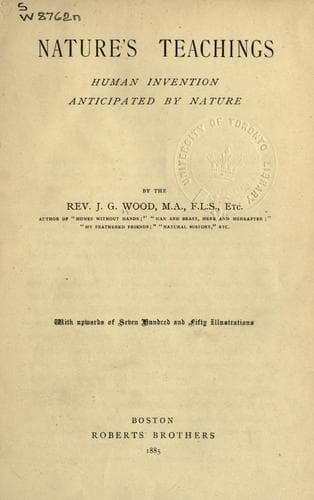
Nature's Teachings: Human Invention Anticipated by NatureWood, J. G. (John George)
History
Nature's Teachings: Human Invention Anticipated by Nature
Wood, J. G. (John George)
Inventions; Natural history
Perhaps the reader may have been unfortunate enough to travel by rail in
the depth of winter, and to be associated with fellow-passengers who
will insist on closing every window, even though the carriage be
crowded. Suppose that on such a day, the weather being perfectly fine,
the train stops at a station, and the guard outside opens the door to
see if another passenger can be accommodated with a place.
No sooner is the door opened than a shower of snow at once fills the
carriage. This is simply the moisture suspended in the air and generated
by human lungs. The rush of cold air at once freezes this moisture and
converts it into snow, thus showing those who will condescend to learn,
that they have been breathing and re-breathing the air that has passed
through a variety of human lungs, and is charged with their different
moistures. I have seen the same phenomenon at a dinner party, where,
after the withdrawal of the ladies, one of the windows was opened.
Now, in Esquimaux-land, it is absolutely necessary to conserve every
atom of heat, for the cold is so intense that if a cask of water be near
a coal fire, only the part next the fire will be thawed, the rest being
ice. Cold, therefore, is a foe which has to be fought and kept away from
the household. Then there are other foes--such as Polar Bears, for
instance--which would be only too glad to get into an igloo and make a
meal of its inhabitants. The Esquimaux architect, therefore, avails
himself of an ingenious device by which he can set both foes at
defiance.
In summer-time he contents himself with a hut made of skins, and merely
hangs a skin over the entrance by way of a door. But in the winter, when
he is driven to his snow-house for shelter, he acts in a very different
manner. Instead of merely cutting an aperture for a door in the side of
the igloo, he constructs a long, low, arched tunnel, so small that no
one can enter the igloo except by traversing this tunnel on his hands
and knees. Sometimes a number of huts are connected with each other, one
or two tunnels leading into the air, and the rest serving merely as
passages from one hut to the other.
[Illustration: NESTS OF FAIRY MARTIN. TOWERS OF SAND-WASP.]
[Illustration: HUTS OF ESQUIMAUX.]
* * * * *
IN Nature are several examples of tunnels constructed on the same
principle.
There are, for instance, the curious nests of the Fairy Martin of
Southern Australia (_Hirundo Ariel_), which bear a singular resemblance
to oil-flasks, the body of the nest being rather globular, and the only
entrance being through a tolerably long, tunnel-like neck.
Then there are the various Weaver-birds of Africa, with their
long-necked nests. Some of these strange edifices look almost like
horse-pistols suspended by the butt, so round is the nest, and so long
and narrow is the tunnel-like entrance.
* * * * *
Public-domain text, read in full here on John Shaqi.
Reviews
Reviews
No reviews yet
Be the first to share your thoughts on this work.
Elsewhere in the archive
Join the Discussion
Join the discussion
Sign in to leave a comment or review.
Sign InorCreate an account