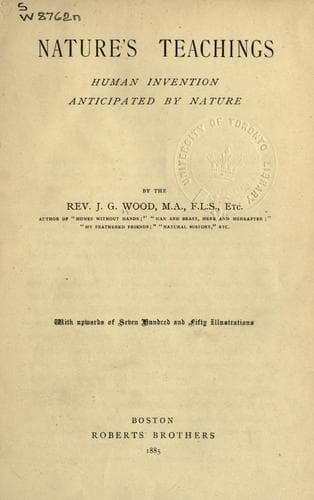
Nature's Teachings: Human Invention Anticipated by NatureWood, J. G. (John George)
History
Nature's Teachings: Human Invention Anticipated by Nature
Wood, J. G. (John George)
Inventions; Natural history
I have several times suffered from them, and would much rather be
severely stung by nettles than undergo the fierce irritation, mixed with
dull heavy pain, which always accompanies the presence of these hairs.
With me, as I suppose would be the case with persons of similar
organization, these hairs cause large, hard tubercles to rise, just as
if potatoes had been placed under the skin. The hairs of the
Processionary Caterpillar have a similar effect, and in France the
authorities have several times been obliged to close the public gardens
for months, so severe was the pain which the caterpillars inflicted on
persons who passed through the spots infested by them.
MUD WALLS.
There is a mode of wall-building which is much in vogue in some parts of
England, and has much to commend itself. This is the Mud or Concrete
Wall.
At first sight, the very name of a mud house gives an idea of poverty
and misery, and is apt to be connected with hovels and pigsties. Mud
walls, however, if properly built, are far warmer and drier than those
of brick, and are even preferred to those of stone, when the latter can
be easily and cheaply obtained. In Devonshire, for example, where even
the cattle-sheds, or “linhays” (pronounced _linny_), and the pigsties
are made of the rich red stone of the county, it is a common thing to
see village houses built of mud. Sometimes the houses are built of stone
to the height of some ten or twelve feet, and the upper parts made of
mud.
[Illustration: NEST OF TERMITE.]
[Illustration: MUD WALL.]
If the builders are in any way fastidious, they make their walls of a
uniform surface by placing two rows of planks on their edges at a
distance from each other proportionate to the thickness of the wall,
pouring the mud between them, and, when it has sufficiently hardened,
shifting the planks. This, however, is not necessary, and detracts much
from the picturesque look of a genuine mud wall, especially when it is
of that rich red which characterizes the Devonshire soil. These mud
walls are locally known by the name of Cob.
* * * * *
WE have not to go very far in Nature to find good examples of the
strength which can be attained by mud walls.
In all parts of the world where Termites, popularly but wrongly called
White Ants, are to be found, the strength and endurance of the mud wall
can easily be tested. Of gigantic dimensions when compared with the size
of the architect, they not only endure the rain-torrents which wash over
them, but can sustain the weight of the wild cattle, which are in the
habit of using them as watch-towers, and this although they are hollow,
and filled with chambers and galleries.
In Southern Africa these nests are much utilised. There is an animal
called by the Dutch settlers the Aard-vark, which feeds almost wholly
on Termites. At night it issues from its burrow, and, being armed with
large and powerful claws, tears a great hole in the side, and devours
the inmates.
Public-domain text, read in full here on John Shaqi.
Reviews
Reviews
No reviews yet
Be the first to share your thoughts on this work.
Elsewhere in the archive
Join the Discussion
Join the discussion
Sign in to leave a comment or review.
Sign InorCreate an account