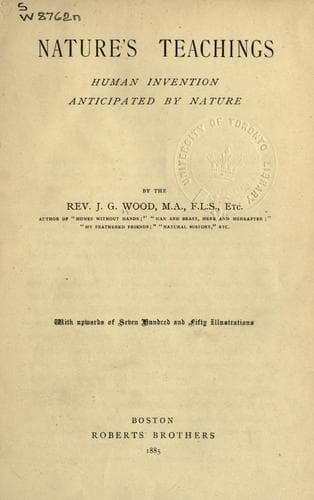
Nature's Teachings: Human Invention Anticipated by NatureWood, J. G. (John George)
History
Nature's Teachings: Human Invention Anticipated by Nature
Wood, J. G. (John George)
Inventions; Natural history
This is very easy, as, while the wood is green, it is so soft that a
blow from a “machete,” or native cutlass, is sufficient to separate it.
With the same instrument the native makes these flat planks into paddles
for his canoe, the soft wood yielding readily even to the imperfect edge
of the rude tool. When the wood dries, it becomes very hard, light, and
singularly elastic, all these properties qualifying it for its object.
I have several of these paddles in my collection. They are much prized
by the natives, and are always stained in various patterns with red and
black dyes.
In consequence of the use which is made of this tree, it goes by the
popular name of “paddle-wood.”
THE TUNNEL USED AS A PASSAGE.
As to this division of the subject, I have not been quite sure where it
should be placed, but think the present position a tolerably appropriate
one.
We have already, in the igloo of the Esquimaux and the winter dwelling
of the seal, found examples of the Tunnel when used as an appendage to
the houses and a means of security. We now come to the Tunnel as
affording the means of locomotion.
[Illustration:
TUNNEL OF ANOMMA.
PHOLAS.
SHIP-WORM.]
[Illustration: RAILWAY TUNNEL.]
Take, for example, our own railway system. Had it not been for the power
of tunnelling, the railway would have lost nearly its whole value, for
it would have been restricted to local districts, and could not have
penetrated, as it now does, to all parts of the country, without
reference to hill, dale, or level ground. Our present system of
engineering has wonderfully developed the capability of tunnelling. In
former times it was thought a most wonderful feat to drive a tunnel
under the Thames, while in these days the tunnel through Mont Cenis has
been completed, and we are hoping to make a submarine tunnel from
England to France.
* * * * *
IN Nature we can find many examples of Tunnels used for similar
purposes. The silken tunnel of the Wax-moth larva has already been
mentioned, and we now come to Tunnels where earth in some form, and not
silk, is the material of which they are constructed.
The lowermost figure on the left-hand side of the illustration
represents that well-known and most destructive burrower, the Ship-worm
(_Teredo_), which, by the way, in spite of its popular name, is not a
worm, but a mollusc. This creature has a peculiar interest for
engineering, inasmuch as its mode of working gave Brunel the first idea
of subaquatic tunnelling in loose, sandy soil, just as the Victoria
Regia leaf gave to Paxton the idea which afterwards developed into the
Crystal Palace.
Public-domain text, read in full here on John Shaqi.
Reviews
Reviews
No reviews yet
Be the first to share your thoughts on this work.
Elsewhere in the archive
Join the Discussion
Join the discussion
Sign in to leave a comment or review.
Sign InorCreate an account