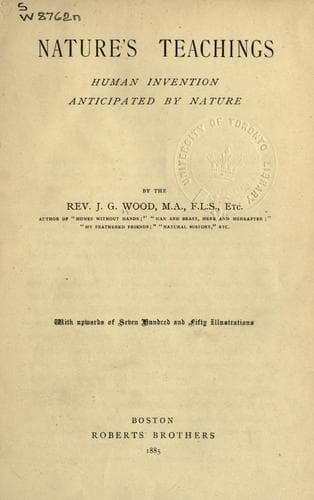
Nature's Teachings: Human Invention Anticipated by NatureWood, J. G. (John George)
History
Nature's Teachings: Human Invention Anticipated by Nature
Wood, J. G. (John George)
Inventions; Natural history
The Eddystone Lighthouse: its Position, and the Difficulties of
building it.--Destruction of successive Lighthouses.--Smeaton’s
Idea of Form borrowed from the Tree-trunk.--Mode of
building.--Rooting it into the Rock.--Principle of the
Dovetail.--Bones of the Human Skull, and their Articulation.--The
Dam, and its Uses to Man.--The Lock and the Water-mill.--Dam of the
Beaver: its Objects and Mode of Construction.--Popular Errors with
regard to the Dam.--Subterranean Dwellings.--The Indian Palace, and
its Use in Summer.--Subterranean Dwellings in Kamschatka, and their
Use in Winter.--The Wood or Horse Ant, and its double
Dwelling.--The upper and lower Nests used according to the Amount
of Warmth required.--Section of the Nest, and a Glimpse into its
Interior.--The Pyramid.--Derivation of its Name.--Natural Objects
from which the Form was derived.--Subaquatic Mortar or Cement, and
its Use to Man.--Subaquatic Cement used by the Caddis, the
Stickleback, the Terebella, the Sabella, the Serpula, and
others.--Paint and Varnish, and their Utility to Man.--Propolis as
used by the Hive Bee, and the Source whence it is obtained.
We now come to some points in Architecture which cannot well be grouped
together, and must therefore be treated as Miscellanea.
Our first example is one which was avowedly based upon an imitation of
Nature, namely, the celebrated Eddystone Lighthouse, and we shall see
that in two points--first its form, and next the mode in which the
stones were fixed together--Nature had been closely followed by the
architect.
Unlike ordinary lighthouses, this edifice had to be constructed so as to
endure the full force of waves as well as wind. A few miles from the
southern coasts of Devon and Cornwall there is a rock which in former
times greatly endangered the ships which passed along the Channel.
Several attempts were made to build a lighthouse on this dangerous spot.
Winstanley’s lighthouse, which was finished in 1700, was wholly swept
away three years later, together with the architect himself, and some
workmen who were engaged in repairs. So terrific is the force of the
elements on this spot, that the lighthouse was entirely destroyed, and
the only vestiges of it that were ever discovered were some iron bars
and a piece of chain.
Public-domain text, read in full here on John Shaqi.
Reviews
Reviews
No reviews yet
Be the first to share your thoughts on this work.
Elsewhere in the archive
Join the Discussion
Join the discussion
Sign in to leave a comment or review.
Sign InorCreate an account