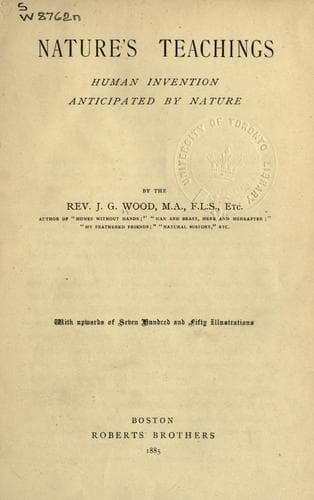
Nature's Teachings: Human Invention Anticipated by NatureWood, J. G. (John George)
History
Nature's Teachings: Human Invention Anticipated by Nature
Wood, J. G. (John George)
Inventions; Natural history
Ingenious as is the animal in the construction of its dam, it is not
nearly so accomplished an architect as was once supposed. We were told
in the earlier books of Natural History that the Beaver felled trees,
cut off their branches into convenient lengths, and sharpened one end,
like an ordinary stake. Then they were said to drive the sharp end of
the stakes into the bed of the river, to set them side by side, to
interweave smaller branches among them, and lastly, to fill up the
interstices with mud, leaves, and similar materials. In fact, they were
supposed to build a “wattle-and-daub” wall, like that which is in use at
the present day in Southern Africa.
[Illustration: DAM MADE BY BEAVER. DAM MADE BY MAN.]
The Beaver does nothing of the kind. It needs a dam, and it makes one
which is far stronger than the wattle-and-daub could be. It begins by
felling a tree, and letting it lie across the stream, in some place
where the banks are high and tolerably steep. A bend of the river is
usually chosen for the new dam. Should not the tree be long enough for
the Beaver’s purpose, two trees are felled, one on either side, so that
their branches meet in the middle.
These branches, and not any supposed stakes, are really the upright
supports of the dam. The trees being thus laid, the Beaver cuts down
branches from four to six feet in length, and lays them horizontally
among the boughs of the fallen trees. Having thus made the foundations,
so to speak, of its dam, the Beaver then proceeds to fill in the spaces
with roots, grass-tufts, leaves, mud, and, indeed, almost anything on
which it can lay its paws.
After this, the Beaver has to take but little trouble, for the stream
itself becomes a silent, slow, but constant labourer, lodging floating
debris against the dam, and making a sloping bank which much adds to its
strength. By degrees, seeds that lodge on the dam spring into life, and
their roots act like chains, binding the materials more closely
together. Willow twigs too, if they lodge on the dam and be left
undisturbed, are sure to “strike,” as the gardeners say, and further to
bind the structure together.
It is evident, from this short description, that the lower part of the
dam is more solid than the upper. In fact, the floods are tolerably sure
to wash away some eight or ten inches of the upper part every year, and
the Beavers have to make it afresh. The height of these dams is not
nearly so great as is generally supposed. Mr. Green, a practical
trapper, states that the highest which he ever saw was only four feet
six inches in height, and that the average is under three feet.
Public-domain text, read in full here on John Shaqi.
Reviews
Reviews
No reviews yet
Be the first to share your thoughts on this work.
Elsewhere in the archive
Join the Discussion
Join the discussion
Sign in to leave a comment or review.
Sign InorCreate an account