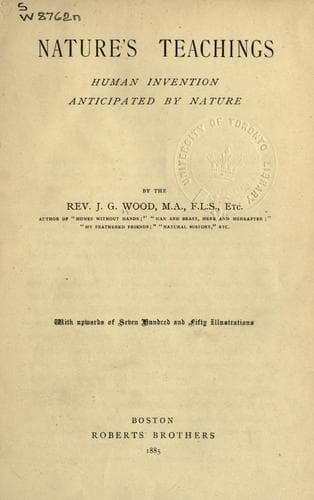
Nature's Teachings: Human Invention Anticipated by NatureWood, J. G. (John George)
History
Nature's Teachings: Human Invention Anticipated by Nature
Wood, J. G. (John George)
Inventions; Natural history
In order to make these houses, they begin by digging a large hole in the
ground, about nine or ten feet in depth. This they line with poles and
sticks, making, in fact, a wall as of a house. A stout conical roof is
then raised over the hole, and upon the roof earth is thickly strewn and
beaten down, just as has been mentioned when treating of the ice-house.
The only access to this strange house is by a circular aperture in the
centre of the conical roof, serving at once the purpose of a door, a
chimney, and a window. A notched pole answers as a ladder, a low wooden
dais placed against the wall serves as a bed or a chair, for there is no
other, and a few stones placed together act as a fireplace.
* * * * *
IN looking at both these subterranean dwellings, I could not but be
reminded of a very common insect which has a double dwelling, one moiety
being aboveground, and the other moiety below it. This is the common
Wood-ant (_Formica rufa_), whose large, leafy hills are so plentiful in
some of our woods. On account of its size, this species is sometimes
called the Horse-ant.
At first sight the nest looks something like a small haycock, made
entirely of chopped grass. When examined more nearly, it will be found
to consist mostly of grass-stems, little bits of stick, and leaves.
Those of the fir are in great request, for when they are dry they are
very light, and their form enables the Ant to interweave them with each
other, so as to form the necessary tunnels and galleries which line the
interior of the nest. The materials seem most unpromising, but they are
used with wonderful skill, such as no human fingers could equal.
After a little while a number of entrances into the nest are visible.
They are almost invariably sheltered by projecting leaves, which act as
porches, so that when the nest is viewed from above, they are almost
entirely hidden. Each of these openings runs into one of the main
galleries of the nest, and from thence issues a perfect labyrinth of
passages.
This, however, is only half the nest, for the galleries and tunnels
extend far beneath the surface of the earth, and have sundry enlarged
portions or chambers wherein the immature pupæ may lie during their
period of helplessness.
Owing to the very loose structure of the upper nest, and the tendency of
the earth to fall into the galleries of the lower nest, it is very
difficult to obtain a trustworthy view of the interior. Perhaps I may
here be allowed to extract a passage from my “Insects at Home,” the
description of the nest and its interior having been written almost on
the spot:--
Public-domain text, read in full here on John Shaqi.
Reviews
Reviews
No reviews yet
Be the first to share your thoughts on this work.
Elsewhere in the archive
Join the Discussion
Join the discussion
Sign in to leave a comment or review.
Sign InorCreate an account