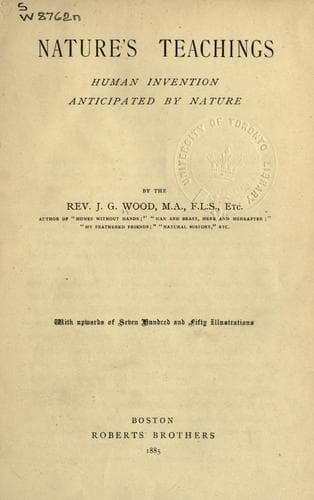
Nature's Teachings: Human Invention Anticipated by NatureWood, J. G. (John George)
History
Nature's Teachings: Human Invention Anticipated by Nature
Wood, J. G. (John George)
Inventions; Natural history
Before seed can be sown, it is necessary that the earth should be broken
up, and, owing to the structure of the human frame, this task cannot be
fulfilled by man without a tool which will enable him to rival many of
the lower animals, _i.e._ make use of those digging appliances which
have been furnished by Nature.
[Illustration: HEART-URCHIN. DIGGING-STICK.]
It is evident that the first earth-breaking tool must have been a
pointed stick, and we find that in Southern Africa, in parts of Asia,
and in Australia the Digging-stick is still in use for the purpose of
breaking up the ground. The Australians are wonderful adepts in the use
of the Digging-stick, which is one of the simplest of instruments, being
merely a stick some two feet in length, pointed at one end, and the
point hardened in the fire.
The mode of using it is by holding it perpendicularly, pecking it into
the ground, and throwing out the loosened soil with the hands. In this
way they can excavate with such rapidity, that a strong navvy, armed
with the best spade, would not be able to keep pace with a black man
armed only with his “katta,” or digging-stick.
In Africa the Digging-stick is used in exactly the same manner, and is
generally made more weighty and effective by having a perforated stone
fastened on the handle.
* * * * *
HERE, again, man has been anticipated by Nature, and the savage of
Australia or Africa digs in exactly the same manner as the common
Heart-urchin of our shores, sometimes called the Hairy Urchin, in
consequence of the number and fineness of the spines, which look just
like hairs to the naked eye. The scientific name of this creature is
_Amphidotus cordatus_.
Mr. Gosse, in his “Evenings at the Microscope,” gives so admirable an
account of the mode of digging employed by the Hairy Urchin that I
cannot do better than employ his own words. After describing the variety
of structure of the different spines with which the shell is so thickly
set, he proceeds as follows:--
“But what is the need of so much care being bestowed upon the separate
motion of these thousands of hair-like spines, that each should have a
special structure, with special muscles for its individual movement? The
hairs of our head we cannot move individually: why should the
Heart-urchin move his?”
Public-domain text, read in full here on John Shaqi.
Reviews
Reviews
No reviews yet
Be the first to share your thoughts on this work.
Elsewhere in the archive
Join the Discussion
Join the discussion
Sign in to leave a comment or review.
Sign InorCreate an account