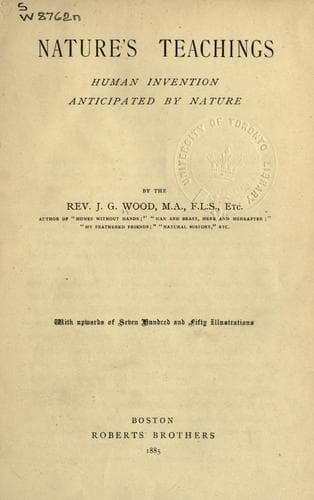
Nature's Teachings: Human Invention Anticipated by NatureWood, J. G. (John George)
History
Nature's Teachings: Human Invention Anticipated by Nature
Wood, J. G. (John George)
Inventions; Natural history
Simple as the scissors may seem, they combine several very important
principles, namely, the inclined plane, the lever, and the cutting edge.
Were they to be merely two edges moving directly upon each other, their
effect would be comparatively slight; but, owing to the manner in which
the blades are fixed at one end, they are drawn as it were over the
object between them, and so divide it with comparative ease. In some
instruments, such as the pruning scissors, there is only one cutting
blade, the other being used merely as a support for the branch which is
being cut.
A well-known example of a single cutting blade is found in the
guillotine. In the earliest times of this invention an ordinary axe-head
was suspended above the neck of the criminal. It was found, however,
that its operation was very uncertain, simply because the blow was a
direct one, and not oblique. The blade was then set obliquely, as in the
present machine, and its effect was absolutely certain.
Perhaps some of my readers may be swordsmen, and therefore know the
power of the “drawing cut,” by which a great effect may be produced with
very little apparent exertion. Even in the simple operation of cutting
bread we always use the knife diagonally, though perhaps we may be
ignorant of the principle of the inclined plane.
Next comes the principle of the lever, as exemplified by the handles of
the scissors. By lengthening these handles, the power of the blades is
enormously increased, as may be seen in the various shears in any great
iron-works, which cut through thick iron as if it were butter. Our own
garden shears for trimming borders show very well the power of the long
arms and short blade.
* * * * *
IN the animal world we find many examples of natural shears, one of the
best of which is afforded by the jaws of the Tortoise or Turtle. Owing
to the manner in which they feed, whether they be vegetarians or
carnivorous, their jaws are made for cutting, and not for lacerating or
mastication. They have no teeth, but each jaw is furnished with a horny
edge, as sharp as a knife-blade, and very strongly made. With these jaws
the animal can shred to pieces the objects which it attacks, just as if
it had been furnished with a pair of veritable shears. Any one who has
possessed an ordinary Tortoise must have noticed the havoc which it will
occasionally make in a garden. I had one of these reptiles for some
years, and was obliged to keep it under restraint, in consequence of the
power of its jaws.
Being a Tortoise of discrimination, it took a great fancy to the
strawberry beds, and invariably picked out the ripest and best-flavoured
fruit. Reversing the usual proverb of making two bites at a cherry, the
Tortoise always took two bites at a strawberry, and sometimes three or
four, according to its size.
Public-domain text, read in full here on John Shaqi.
Reviews
Reviews
No reviews yet
Be the first to share your thoughts on this work.
Elsewhere in the archive
Join the Discussion
Join the discussion
Sign in to leave a comment or review.
Sign InorCreate an account