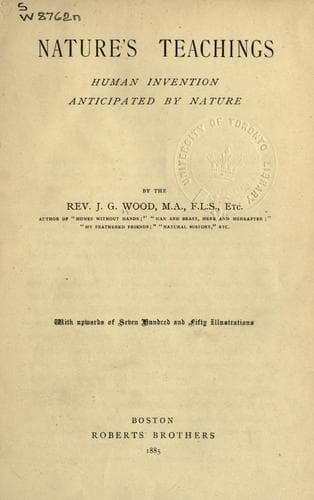
Nature's Teachings: Human Invention Anticipated by NatureWood, J. G. (John George)
History
Nature's Teachings: Human Invention Anticipated by Nature
Wood, J. G. (John George)
Inventions; Natural history
There is a very pretty English insect which admirably exemplifies the
power of the natural scissors. This is the Great Green Grasshopper
(_Acrida viridissima_), which is equally voracious in all its stages of
existence. It is always ready to use these jaws, and I do not recommend
the reader to allow his finger to get between them, or their points will
probably meet.
One of these insects, indeed (_Decticus griseus_), has derived the name
of Wart-biter from its supposed use in curing warts. All that was
needful was to catch a Wart-biter, and hold one of the warts to its
jaws. It was sure to seize the wart, and bite it smartly, and there was
a firm belief that any one thus bitten would be freed from the unsightly
excrescence. The bite of the shear-like jaws caused much pain at the
time, and this very pain had in all probability something to do with the
cure.
* * * * *
AN admirable example of the insect jaws used as scissors is to be found
in the well-known Leaf-cutter Bees, insects belonging to the genus
Megachile.
They make their nests in burrows, sometimes in wood, and sometimes in
the ground, and form them in a very singular manner. After fixing upon a
suitable burrow, the Bee goes off to a tree, generally a rose, and,
using her jaws just as a tailor uses his shears, cuts off a nearly
semicircular piece of leaf, flies away with it to her home, and, by dint
of bending, pushing, and pulling it, she forces it to the bottom of the
cell. Successive pieces of leaf follow, until she has made a
thimble-shaped cell, and she then places at its end an egg and a supply
of honey and pollen.
Cell after cell succeeds, each being introduced into its predecessor
just as thimbles are packed. Judging from a specimen in my collection,
there are about eight layers of leaves to form the walls of the cell,
and the average length of each piece of leaf rather exceeds half an
inch. The entire length of the cell-group is two inches and a half. The
leaf-slices are always cut from the edge, and, in my specimen of the
nest, the serrated outer edges of the leaves are all in one direction.
Should any of my readers find one of these nests, it will be as well for
them to dip a needle point into diamond cement, and introduce it under
the outermost coating of leaves. Otherwise, when the leaves are dry, and
the insects break their way into the open air, the cells will probably
fall to pieces.
Public-domain text, read in full here on John Shaqi.
Reviews
Reviews
No reviews yet
Be the first to share your thoughts on this work.
Elsewhere in the archive
Join the Discussion
Join the discussion
Sign in to leave a comment or review.
Sign InorCreate an account