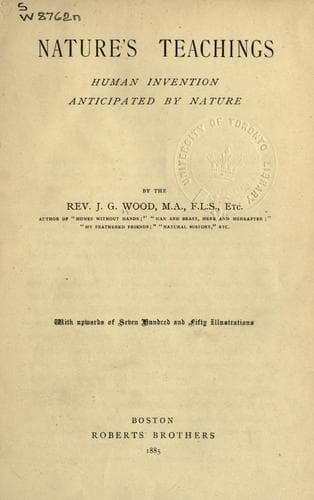
Nature's Teachings: Human Invention Anticipated by NatureWood, J. G. (John George)
History
Nature's Teachings: Human Invention Anticipated by Nature
Wood, J. G. (John George)
Inventions; Natural history
The Bradawl and the Gimlet defined.--Natural Bradawls.--The
Ichneumon-flies.--A Pimpla engaged in Boring Operations.--Principle
of the Wedge.--Resisting Power of Earth.--Pitching Tents in
Sand.--Hidden Forces of Nature.--The Aloe-leaf and its Growth.--A
cruel Punishment.--Natural Gimlets.--Ovipositor of the Sirex, and
its Analogy to a Carpenter’s Gimlet.--The Auger and the
Gad-fly.--Striking Tools.--The Hammer.--Origin and Development of
the Tool.--The Axe.--The Woodpecker and the Nuthatch.--The
Ivory-billed Woodpecker.--Grasping Tools.--Pincers and their
Modifications.--Sugar-tongs and Coal-tongs.--Natural
Pincers.--Bivalve Molluscs.--The Clam’s Grip.--The Earwig.--Crab
and Lobster Claws.
BORING TOOLS.
Next in importance to the edged tools which cut, come the pointed tools
by which holes can be bored. We have an abundance of such tools, but
they can all be reduced to two types, namely, those which, like the
Bradawl, are forced between the fibres, and those which, like the
Gimlet, cut away the material as they pass through it.
They may, again, be shown to be different modifications of a single
principle--_i.e._ that of the Wedge or Inclined Plane, which, as has
already been shown, is identical with that of the screw. The Bradawl is,
in fact, a sharp wedge, which is forced through the fibres, sometimes
being merely forced between them, and sometimes cutting them, and thus
forcing aside the severed fibres.
A natural example of the Bradawl is to be found in various
Ichneumon-flies, especially those with very long ovipositors, which are
intended for boring into wood.
All the Ichneumons are parasitic, laying their eggs in the larvæ of
other insects, mostly those of moths and butterflies. Generally these
larvæ exist in the open air, and the Ichneumon-fly has little difficulty
in piercing them. But there are some which live either in wood or
underground, and, in order to reach their hidden bodies, the Ichneumon
is furnished with an extremely long and sharply pointed ovipositor.
This wonderful instrument is not so thick as an ordinary horsehair,
although it is composed of three portions, and seems to be utterly
inadequate to the task which it has to perform. Ascertaining by its
instinct the exact locality of the caterpillar which it desires to
pierce, the Ichneumon-fly clings firmly to the tree, bends the body so
as to bring the point of the ovipositor against the wood, and, by moving
the abdomen backwards and forwards, gradually works the instrument into
the wood, sometimes piercing it to a considerable depth.
Public-domain text, read in full here on John Shaqi.
Reviews
Reviews
No reviews yet
Be the first to share your thoughts on this work.
Elsewhere in the archive
Join the Discussion
Join the discussion
Sign in to leave a comment or review.
Sign InorCreate an account