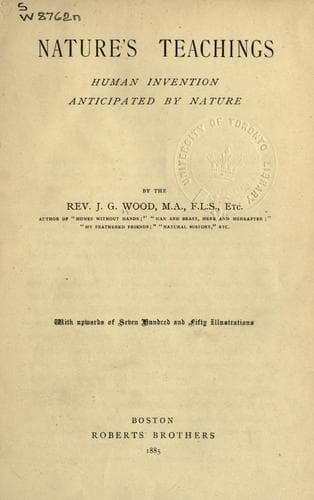
Nature's Teachings: Human Invention Anticipated by NatureWood, J. G. (John George)
History
Nature's Teachings: Human Invention Anticipated by Nature
Wood, J. G. (John George)
Inventions; Natural history
Considering, therefore, that such fragile things as young grass-blades
can force their way through the superincumbent weight, we can but be
amazed at the aggregate of active force which is in full operation in
every pasture field and garden lawn.
As far as I know, not being much of a botanist, every seed that springs
up does so on the wedge principle, though the form of the wedge may be
varied.
A terrible example of the force which is exercised by this principle
among the vegetables is shown in some parts of the world where the Aloe
flourishes in a wild state. In our colder clime the Aloe, though it does
live in the open air, is a slow-growing plant. But, in its own land, it
shoots up with a surprising vigour, and its sharply pointed and
saw-edged leaves are said to grow to the extent of six inches in a
single night.
Taking advantage of this rapid, and, at the same time, powerful growth,
the natives, when they want to punish a man with more than ordinary
severity, tie him hand and foot, and bind him to the earth just over a
sprouting aloe plant, and leave him there. In twenty-four hours the man
is nearly certain to be dead, the aloe-leaf having forced itself
completely through his body. Or, if he be not actually dead, he lives in
frightful tortures, which are continually increased by the flinty point
and notches forcing themselves slowly, but surely, through the body.
* * * * *
FOR an example of the Gimlet we may take the ovipositor of the Sirex, an
insect which I believe has no popular name. It is coloured much after
the same manner as the hornet, and is often mistaken for that insect by
those who are not versed in entomology. And, as its long and straight
ovipositor is generally taken for a hornet’s sting, the insect assumes a
double terror to the ignorant.
Now, the real fact is, that in its larval stage of existence the Sirex
feeds upon the wood of the fir-tree--a diet which, to our ideas, is
about as unsatisfactory as can well be imagined. In order that the young
Sirex may be within reach of food, the egg must be introduced deeply
into the body of the tree, and, for the egg to be so received, a channel
must be cut for it.
This is done by means of the marvellously formed ovipositor. Many
admirable descriptions have been given of the head of this instrument
and its boring powers, but I am not aware that any one has noticed the
secondary cutting blades that are set along the shaft of the principal
borer, and which answer exactly the same purpose as the spiral cutting
edge of the gimlet or auger.
Not being desirous of repeating my own observations in different words,
I transfer to these pages a short account of the ovipositor of the
Sirex, as examined by me when writing my work on British Insects,
entitled “Insects at Home,” and published by Messrs. Longmans and Co.:--
Public-domain text, read in full here on John Shaqi.
Reviews
Reviews
No reviews yet
Be the first to share your thoughts on this work.
Elsewhere in the archive
Join the Discussion
Join the discussion
Sign in to leave a comment or review.
Sign InorCreate an account