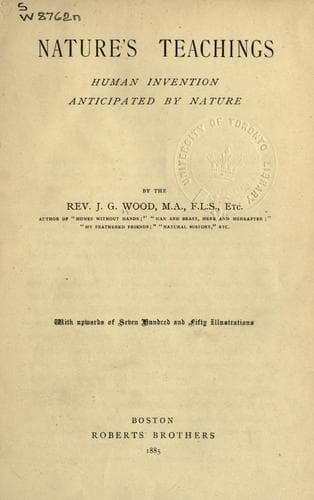
Nature's Teachings: Human Invention Anticipated by NatureWood, J. G. (John George)
History
Nature's Teachings: Human Invention Anticipated by Nature
Wood, J. G. (John George)
Inventions; Natural history
The end of the ovipositor is developed into little projections, some of
which are armed with hard, sharp points, which act exactly like the
cutting edge of the auger. This elaborate appliance is necessary on
account of the thick, tough skin of the ox, which the Gad-fly has to
penetrate before it can deposit its eggs. Perhaps the reader may be
aware of the fact that the modern system of cutting channels in stone
with the diamond point, as was so well exemplified in the Mont Cenis
Tunnel, is but an imitation, and an imperfect one, of the method adopted
by the Gad-fly. We shall soon recur to this instrument.
STRIKING TOOLS.
If we search the records of antiquity as left by races of men that have
for countless ages vanished from the face of the earth, we shall find
that in some shape or other the Hammer was a tool in constant use, and
that in principle, though not in material, there was no difference
between the Hammer of the Stone Age and that of a blacksmith of the
present day.
The development of the instrument can easily be traced, especially as it
is a tool which does not admit of much elaboration.
The original hammer was evidently a simple stone, and answered equally
as a tool and a weapon. As, however, man progressed towards
civilisation, he found that the stone itself was insufficient for his
needs, and that he required much more force. The most obvious mode of
doing so was to take a larger stone, but this expedient soon became
valueless, inasmuch as a large stone was a cumbrous instrument to
handle, and could not be directed with any certainty or delicacy.
The principle of the lever was then applied to the stone, which was
affixed to a handle, and thus became elevated into the rank of a
comparatively civilised tool. Sometimes the stone had a hole bored
through it, into which the handle of the hammer was inserted, as is the
case with most of our present hammers and pickaxes. Sometimes the end of
the handle was enlarged, and the stone thrust through it, as is now done
with the axes of Southern Africa. Sometimes a long, flexible rod was
used by way of handle, the centre of it taking two turns round the
stone, and the ends being lashed together. Handles thus made may be seen
in any blacksmith’s forge of the present day.
The tool thus made was soon developed into various forms for different
uses. By lengthening and pointing the head, it became a pick for
loosening the earth. By widening and flattening the head, it became a
hatchet; and, by performing the same alteration in the pickaxe blade, it
became an adze. I possess a singularly ingenious tool from Borneo, in
which the head is movable, so as to be used as a hatchet or adze at
pleasure.
Public-domain text, read in full here on John Shaqi.
Reviews
Reviews
No reviews yet
Be the first to share your thoughts on this work.
Elsewhere in the archive
Join the Discussion
Join the discussion
Sign in to leave a comment or review.
Sign InorCreate an account