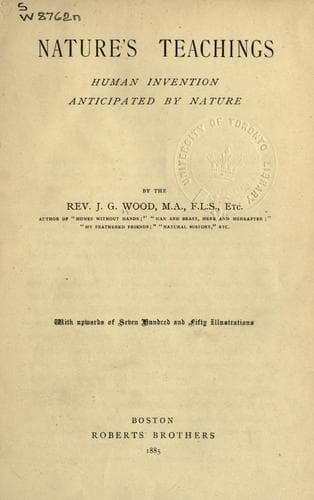
Nature's Teachings: Human Invention Anticipated by NatureWood, J. G. (John George)
History
Nature's Teachings: Human Invention Anticipated by Nature
Wood, J. G. (John George)
Inventions; Natural history
“I now tied a string round his leg, and, fastening it to the table,
again left him. I wished to preserve his life, and had gone off in
search of suitable food for him. As I re-ascended the stairs, I heard
him again at work, and on entering had the mortification to perceive
that he had almost ruined the mahogany table to which he was fastened,
and on which he had wreaked his whole vengeance.”
The beak of the Woodpecker was employed upon its new master quite as
forcibly as upon walls and furniture, but Wilson was of too generous a
nature to resent his injuries, and lamented sincerely when the bird
died.
The reader will probably observe that the Hammer which has been given as
an illustration of this principle is the ordinary geologist’s hammer,
and that it has been selected because its head is so formed that one end
can be employed for the usual tasks of a hammer, while the other end,
with its slight curve and sharp point, is, in fact, a sort of pickaxe,
and used for the same purposes. Indeed, this instrument is an almost
exact reproduction of the stone hammer which has already-been mentioned,
the blunt end being represented by the carved head, and the sharp end by
the pickaxe point.
GRASPING TOOLS.
Already we have spoken of the Shears and Scissors, together with their
mode of action and dependence upon leverage. We now come to a set of
tools which, although equally dependent on leverage, develop that power
by grasping instead of cutting. Without these tools, the arts and
sciences could have scarcely made themselves felt, as there are but few
manufactures in which the artificer does not require a grasping power
far superior to that of the human hand.
Perhaps the enormous power of the Pincers is never shown to better
advantage than in the great iron-works, where enormous masses of
white-hot metal have to be brought under the blows of the steam hammer.
I do not know of anything which affords a more imposing realisation of
the Divine command that man is to subdue the earth as well as to
replenish it. There is the vast hammer, striking blows which are felt
throughout a large area as if a succession of earthquakes had been let
loose. In the furnace there is an enormous mass of iron, heated to such
a degree that an unpractised eye could no more dare to look at it than
to stare a midsummer sun out of face.
Public-domain text, read in full here on John Shaqi.
Reviews
Reviews
No reviews yet
Be the first to share your thoughts on this work.
Elsewhere in the archive
Join the Discussion
Join the discussion
Sign in to leave a comment or review.
Sign InorCreate an account