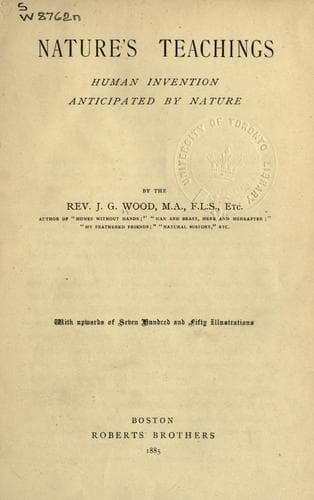
Nature's Teachings: Human Invention Anticipated by NatureWood, J. G. (John George)
History
Nature's Teachings: Human Invention Anticipated by Nature
Wood, J. G. (John George)
Inventions; Natural history
A somewhat more complicated form of lens is called the “Meniscus,” one
side of which is convex and the other concave. A good example of the
meniscus may be found in the old-fashioned watch-glass, before
watchmakers took to flattening them, and watch-wearers were not ashamed
to carry a “turnip,” in which there was room to spare for the works. If
a section of such a glass were taken, it would assume the form of a
half-moon. This, in fact, is the meaning of the term “meniscus,” which
is a Greek word, signifying a little moon. If the same glass were solid,
or even filled with water, it would form a “plano-convex” lens.
Of course the outer curve of the meniscus must be larger than the inner
curve, but in some cases the disproportion is very strongly marked, the
outer curve being very large, and the inner curve very small. An example
of such a meniscus may be seen in the human eye. If the reader will
refer to the illustration on page 280, in which the structure of the eye
is shown, he will see the meniscus lens in combination with the double
convex. The former has already been explained, and the latter is formed
by the vitreous humour which fills nearly the entire globe of the eye.
Its larger curve is due to the form of the eyeball, and the smaller to
the convex lens.
LONG AND SHORT SIGHT.
It has already been mentioned that the focus of a convex lens is shorter
in proportion to its convexity, and that in consequence its magnifying
power is increased. For example, the large glasses through which
pictures are viewed are comparatively thin in proportion to their
diameter, while the lenses employed for the highest powers of the
microscope are scarcely larger than small shot, and nearly as globular.
It naturally follows that any instrument to which a lens is adapted,
whether it be microscope or telescope, must depend for its focus on the
greater or less convexity of the lens in question.
[Illustration: FRAME OF OWL’S EYE. LENS OF DITTO.]
[Illustration: SHORT AND LONG SIGHTED EYES (WITH SPECTACLES).]
Again taking as our example the human eye, we find that there are very
few persons who from youth to age possess or preserve eyes which can
read small type at a moderate distance, and can clearly define the
outlines of distant objects. Nearly all people, even if in their youth
they possess good sight, lose it as they grow older. They can discern
distant objects well enough, but, when they come to reading, they are
obliged to hold the book at arm’s length before they can distinguish the
letters.
This defect is caused by the insufficient convexity of the lens, so that
the focus is thrown too far back, and it is corrected by wearing
spectacles sufficiently convex to supply the deficiency in the lens of
the eye.
Public-domain text, read in full here on John Shaqi.
Reviews
Reviews
No reviews yet
Be the first to share your thoughts on this work.
Elsewhere in the archive
Join the Discussion
Join the discussion
Sign in to leave a comment or review.
Sign InorCreate an account