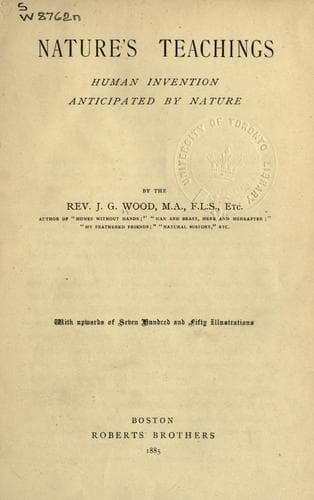
Nature's Teachings: Human Invention Anticipated by NatureWood, J. G. (John George)
History
Nature's Teachings: Human Invention Anticipated by Nature
Wood, J. G. (John George)
Inventions; Natural history
* * * * *
[Illustration: NESTS OF EUMENES.]
[Illustration: ANCIENT NECKED POTTERY.]
There is a South American insect also belonging to the solitary wasps,
and remarkable for building a round nest exactly similar in material,
and nearly identical in shape, with that of the Eumenes. Its scientific
title is _Trypoxylon aurifrons_. The nest of this insect has a much
wider mouth than that of the Eumenes, and exactly resembles the upper
left-hand jar in the illustration.
* * * * *
ANOTHER South American solitary wasp, belonging to the genus
Pelopœus, makes nests of similar material, but nearly cylindrical in
shape instead of globular. The nest is built up of successive rings of
moistened and well-kneaded clay, exactly as human houses are built by
bricklayers. Indeed, the process of making a Pelopœus’ nest has been
happily compared to that of building a circular chimney.
I may as well mention here that the name Pelopœus is formed from a
Greek word signifying mud, and that the entire word may be translated as
“mud-worker.”
As a proof that these insects possess reason as well as instinct, Mr.
Gosse mentions that one of them, instead of making her nest for herself,
utilised an empty bottle, and, after storing it with spiders, stopped up
the mouth with clay. Finding, after an absence of a few days, that the
nest had been disturbed, she removed the spiders, inserted a fresh
supply, and then closed the mouth as before.
BALL-AND-SOCKET JOINT.
We will now see how some of the most useful mechanical inventions have
had their prototypes in Nature.
There is, for example, the well-known “Ball-and-socket joint,” without
which many of our instruments, especially those devoted to optical
purposes, would be impracticable.
[Illustration: HIP-JOINT.]
[Illustration: SPINES OF SEA-URCHIN. VERTEBRÆ OF SNAKE.]
[Illustration: BALL-AND-SOCKET JOINT OF MICROSCOPE.]
The figure on the right hand of the illustration represents the
“bull’s-eye” of my own microscope. It will be seen that there is a ball
half sunk in a cup, so that it can be turned in any direction. In point
of fact, the upper part of the ball is nearly concealed by another cup,
but, in order to show the structure, the upper cup has been removed. Who
was the inventor of the ball-and-socket joint I do not know, but I have
little doubt that he must have had in his mind many natural examples of
this joint, three of which are represented in the illustration.
* * * * *
ON the left hand are seen the upper part of the human thigh-bone and
that part of the hip-bone into which it fits.
Public-domain text, read in full here on John Shaqi.
Reviews
Reviews
No reviews yet
Be the first to share your thoughts on this work.
Elsewhere in the archive
Join the Discussion
Join the discussion
Sign in to leave a comment or review.
Sign InorCreate an account