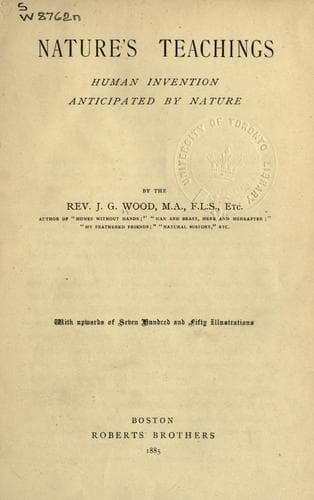
Nature's Teachings: Human Invention Anticipated by NatureWood, J. G. (John George)
History
Nature's Teachings: Human Invention Anticipated by Nature
Wood, J. G. (John George)
Inventions; Natural history
It is just the same in boxing. No one who has the least knowledge of
sparring strikes a round-handed blow, for, putting aside the ease with
which it is parried or avoided, it has scarcely any force in it. When a
boxer hits “straight from the shoulder,” he not only straightens the
Toggle-joint of his left arm, but that of his right knee also, so that
the force of the blow comes quite as much from the leg as the arm.
It is by the right use of this joint that a small man, provided he be an
expert boxer, will easily conquer an ignorant opponent who far surpasses
him in size and weight. I have seen in a sparring-match a man not only
knocked down, but fairly lifted off his feet, by a blow from a smaller
opponent. The blow took effect under the chin, and, as the boxer hit
exactly the right moment in straightening both limbs, a very great force
was exerted with little apparent effort. I do not know which of the two
combatants was the more astonished, the one to find himself on his back
without exactly knowing how he got there, and the other to see his
antagonist prostrate without exactly knowing how the thing was done.
The jointed apparatus by which the heads of carriages are raised or
lowered is a good example of the Toggle, and exemplifies the force which
a comparatively slight piece of machinery can exercise.
* * * * *
ANOTHER form of the Toggle-joint is the process called by sailors
“bowsing” of rope. If a rope be fastened at both ends, and then pulled
in the middle, the ends are drawn forcibly towards each other. This plan
is mostly adopted in getting up sails. When a sail, say the mainsail of
a cutter, has to be hoisted as far as it will go, the last few inches
are always very obstinate. The word is then given to “bowse.” The rope,
or haulyard, is no longer pulled at the end, but a turn is taken round
the cleat, so that it does not give way. The rope is then forcibly
pulled away from the mast, when up goes the gaff a little higher. In
this way, by repeated bowsings, the gaff is coaxed, so to speak, up the
mast, and forced into its place.
Some of the leaf-rolling caterpillars act in a similar manner, by
alternately bowsing and shortening their lines. As, however, their mode
of working will be described under another heading, we will say no more
of them at present.
USEFUL ARTS.
CHAPTER II.
CRUSHING INSTRUMENTS.--THE NUT-CRACKERS, ROLLING-MILL, AND
GRINDSTONE.--PRESSURE OF ATMOSPHERE.--SEED DIBBLES AND DRILLS.
Public-domain text, read in full here on John Shaqi.
Reviews
Reviews
No reviews yet
Be the first to share your thoughts on this work.
Elsewhere in the archive
Join the Discussion
Join the discussion
Sign in to leave a comment or review.
Sign InorCreate an account