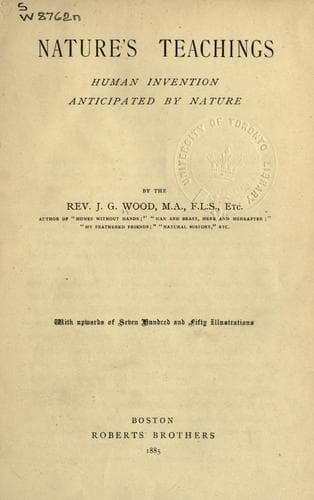
Nature's Teachings: Human Invention Anticipated by NatureWood, J. G. (John George)
History
Nature's Teachings: Human Invention Anticipated by Nature
Wood, J. G. (John George)
Inventions; Natural history
Nothing could be simpler than the machinery used, and nothing could
cause a greater waste of muscular power. Two stones were employed, a
large one upon which the grain was placed, and a smaller which was held
in the hands, and used for grinding the corn to powder, just as the
painters of the last century used to grind their colours. The Kafirs of
Southern Africa use this simple mill, and so exactly do they keep
unconsciously to the customs of long-perished natives, that if one of
their mills were buried for a few years and dug up again, it might be
mistaken for one of the ancient “querns.” As the stone held in the hand
was rounded, it naturally wore a rounded hollow in the lower stone, and
this made the process of trituration easier. Perhaps some of my readers
may have noticed that when a chemist makes up a prescription, and is
obliged to reduce one of the ingredients to powder, he always does so by
rubbing, and not by pounding, as is generally believed. He works the
pestle round and round the mortar with a kind of twisting motion, and
thus obtains a powder much too fine to have been produced by any amount
of pounding.
[Illustration: TOOTH OF ELEPHANT.]
[Illustration: GRINDSTONE.]
The labour of this operation is necessarily very severe, and therefore
the Kafir of the present day, as did his predecessors of the long-lost
races, declines to do it himself, but hands it over to the women. In
Palestine, as in other parts of the world, a simple mill has been
invented, which takes away much of the labour, and, above all, releases
the grinder from the obligation of leaning with her fall weight upon the
upper stone. In this mill the stones are similar. The upper is moved
backwards and forwards round a pivot, and the grain is passed between
them by means of a conical aperture in the upper stone, which answers
the purpose of our “hopper.”
In order to work this mill, two women are required, sitting opposite
each other, with the mill between them, holding the same handle, and
assisting each other in turning the stone backwards and forwards. No one
who has not seen this operation can fully appreciate the force of the
saying that “two women shall be grinding at the mill; the one shall be
taken, and the other left.”
It is worthy of remark that, even at the present day, the custom of
grinding corn is carried out in Palestine as it was so many centuries
ago, and that it is repeated in Southern Africa among the Kafir tribes.
In both parts of the earth the first sound of early morning is caused by
the millstones of the grinding women, and the amount and duration of the
noise afford a sure test of prosperity. Cessation of the millstones
signifies adversity and a thin population, as has been said by a writer
who lived not very far from three thousand years ago. Speaking of
tribulation, he mentions that “the grinders cease because they be few,
and that the doors shall be shut in the streets when the sound of the
grinding is low.”
Public-domain text, read in full here on John Shaqi.
Reviews
Reviews
No reviews yet
Be the first to share your thoughts on this work.
Elsewhere in the archive
Join the Discussion
Join the discussion
Sign in to leave a comment or review.
Sign InorCreate an account