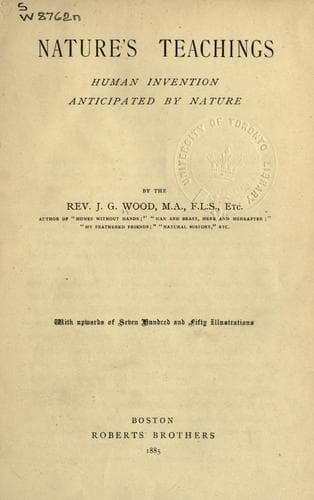
Nature's Teachings: Human Invention Anticipated by NatureWood, J. G. (John George)
History
Nature's Teachings: Human Invention Anticipated by Nature
Wood, J. G. (John George)
Inventions; Natural history
The boy’s well-known toy, the Sucker, is made on exactly the same
principle. A piece of leather, generally circular, though the shape is
not of much consequence, has a hole bored through its centre, so as to
allow a string to be attached. The leather is then soaked in water until
it is quite soft. If it be firmly pressed on any smooth object, such as
a stone, the air is forced from under it, and it becomes capable of
sustaining a weight in proportion to its dimensions. As the air has a
pressure of about fifteen pounds on every square inch, it is easy to
calculate the weight which it will uphold, a margin being left for
imperfection of vacuum.
[Illustration:
SUCKERS OF CUTTLE.
LIMPET.
STAR-FISH.
SUCKING-FISH.
FOOT OF GECKO.
LAMPERN.
CUPPING-GLASS.
PNEUMATIC PEG.
SUCKER.
MAGDEBURG HEMISPHERES.]
* * * * *
THE lower figure represents the instrument called the Magdeburg
Hemispheres, which are made for the purpose of showing the enormous
power of air-pressure. They are two hollowed hemispheres, having their
edges very accurately ground together. When used, a little lard is
rubbed on the edges in order to insure their exact fit, and they are
then pressed tightly together. The air is removed by means of the
common exhausting syringe, and it is found that the two adhere together
with such force that two strong men cannot pull them asunder. But, if
the tap be turned, and air admitted, they come apart without the least
difficulty.
Similarly, if two plates of glass or metal be ground to exactly plane
surfaces, and pressed together, they adhere nearly as strongly as if
they were one solid piece.
* * * * *
WE will now turn from Art to Nature, and examine some natural producers
of vacuum.
One of the most celebrated is that series of suckers which may be found
upon the arms of the various Cuttles. At the upper part of the
illustration a figure is given of part of an arm, on which are four
suckers. When the animal wishes to attach itself to any object, it
presses the disc of the sucker against it, and simultaneously withdraws
the centre, exactly as the boy does with his toy sucker. And, as each
arm contains a great number of suckers, it is evident that the holding
power must be very great. Indeed, on one occasion when a comparatively
small specimen had fastened on a man’s arm, he could not remove it, but
was obliged to have it cut away piecemeal by an assistant.
The common Water-beetle has similar suckers upon its first pair of feet,
and can adhere to smooth surfaces with great tenacity.
* * * * *
Public-domain text, read in full here on John Shaqi.
Reviews
Reviews
No reviews yet
Be the first to share your thoughts on this work.
Elsewhere in the archive
Join the Discussion
Join the discussion
Sign in to leave a comment or review.
Sign InorCreate an account