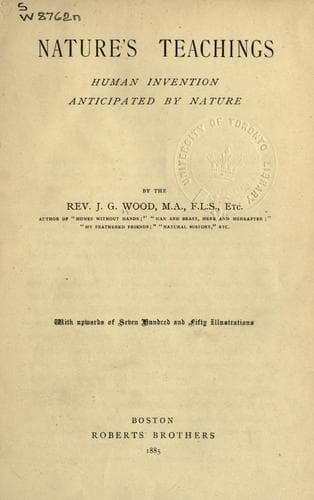
Nature's Teachings: Human Invention Anticipated by NatureWood, J. G. (John George)
History
Nature's Teachings: Human Invention Anticipated by Nature
Wood, J. G. (John George)
Inventions; Natural history
Among the modern improvements in agriculture we may reckon the invention
of the Seed-drill as one of the most important. By means of this
invention, seed is greatly economized, the supply can be regulated, and
the sower knows exactly where every grain of seed goes. There is no
scattering, as in the wasteful broadcast plan, by which the seeds are
flung almost at random over the field, and may or may not fall into the
furrows. The Seed-drill, on the contrary, either stamps holes or ploughs
narrow furrows, measures the seed into them, and in some machines
replaces the earth. The former kind of machine rather deserves the name
of a dibble, and was invented for the purpose of superseding the use of
the hand-dibble.
It is really a pitiful thing to see human beings endowed with reason and
aspirations performing such a task as dibbling by hand, one going
backwards with a dibble in each hand, and the other following and
putting seed into the holes. Yet the field labourers have the greatest
objection to the machine dibble, as, indeed, they have to any sort of
labour-saving machine, thinking that it will lessen the demand for
labour, and prevent them from earning a livelihood.
I well remember how a country clergyman, pitying the hard toil of the
hand-dibblers, took occasion when he visited town to purchase a machine
dibble wherewith one man could set eight rows of beans at once. It was a
very simple affair, comprehensible even by the dull brain of a Wiltshire
labourer. His trouble was all in vain, for no one would use it, and
there was such a disturbance about it in the village, that for the sake
of peace its owner laid it up in a loft and abandoned its use. There
might be some semblance of reason in thinking that it would deprive them
of their field labour, but no cottager would even use it in his own
garden, though it was freely offered to any one who wished to borrow it.
* * * * *
THESE machines have their parallels in Nature, two of which are
represented in the illustration.
The lower left-hand figure represents the female Grasshopper depositing
her eggs. She is furnished with a sharply pointed ovipositor, composed
of two blades. When she is about to lay her eggs, she searches for a
suitable piece of ground, where the earth is tolerably soft, and with
the closed ovipositor bores a hole. She then separates the blades
slightly, and an egg glides between them into the ground, precisely as
is done by the machine dibble with its beans. When I first saw and used
the instrument, some twenty-five years ago, the parallel struck me at
once.
* * * * *
Public-domain text, read in full here on John Shaqi.
Reviews
Reviews
No reviews yet
Be the first to share your thoughts on this work.
Elsewhere in the archive
Join the Discussion
Join the discussion
Sign in to leave a comment or review.
Sign InorCreate an account