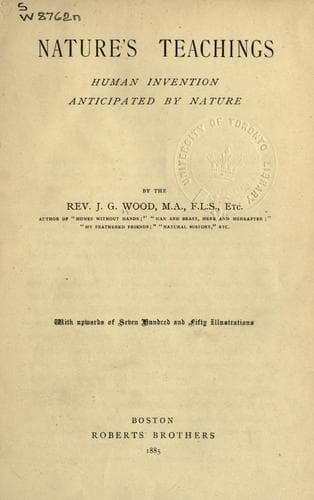
Nature's Teachings: Human Invention Anticipated by NatureWood, J. G. (John George)
History
Nature's Teachings: Human Invention Anticipated by Nature
Wood, J. G. (John George)
Inventions; Natural history
The lower edge of the first pair of wings is turned over in a rather
stiff fold. The upper edge of the second pair of wings has a row of
small, but strong and elastic hooks. When the insect is about to fly,
the hooks are hitched into the fold, and so the wings are fastened
together. These hooks are shown in the illustration, and the reader will
easily see how effective they must be in their operation. An almost
exactly similar structure is found in the feathers of birds, and it is
by means of these tiny hooks that wings are enabled to present a
continuous, light, and elastic surface in the air.
USEFUL ARTS.
CHAPTER IV.
THE STOPPER, OR CORK.--THE FILTER.
Vessels and their Covers.--Corks.--Mode of bottling Wine.--Conical
Corks and Stoppers.--Self-fitting Candles.--Candle-fixers.--The
Vent-peg.--The Blow-guns and their Missiles.--The Serpula and its
Conical Stopper.--The Filter.--The Bosjesman procuring Water.--How
to make a simple Filter.--The Earth as a Filter.--The Sea-mouse, or
Aphrodite, and its filtering Apparatus.--The Duck’s Beak, and its
beautiful Structure.--The Jaw of the Greenland
Whale.--Fork-grinder’s Respirator.--How Insects
breathe.--Spiracles, and their general Structure.--Spiracle of the
Fly.--Experiment upon a Cockroach, and its Result.
THE STOPPER, OR CORK.
This object, as depicted in the illustration, is a product of civilised
life, though, as soon as a savage could make a vessel, he seems to have
made a Cover for it if it were of large diameter, or a Stopper if the
opening were small. Even the very Bosjesman, who is quite unable to make
a clay vessel, and uses empty ostrich eggs by way of water-bottles, is
yet capable of making plugs with which he can stop up the apertures.
Then the Kafir, with his gourd vessels, whether they be for water or
snuff, makes a plug that fits tightly enough to exclude the air, as well
as to retain the contents.
The invention of glass bottles necessarily brought with it the
introduction of a new kind of plug, and a material for such a plug was
found in the bark of the cork-tree, a species of oak. This bark
possesses the capability of compression to a very great extent, and,
being highly elastic, it expands as soon as the pressure is removed.
Thus, in bottling wine, the corks are always made much too large to go
into the mouths of the bottles. They are first dipped in a cup
containing the same wine, and are then compressed violently by a machine
worked by a handle, and which, being practically a powerful pair of
nut-crackers with a rounded gripe, must suit the shape of the cork. It
is then taken out of the machine, and, before it has had time to expand,
is rapidly fitted to the neck of the bottle, and driven home with a
wooden mallet. Expansion then takes place, and the bottle is rendered
air-tight, so that no damage is done to the wine.
Public-domain text, read in full here on John Shaqi.
Reviews
Reviews
No reviews yet
Be the first to share your thoughts on this work.
Elsewhere in the archive
Join the Discussion
Join the discussion
Sign in to leave a comment or review.
Sign InorCreate an account