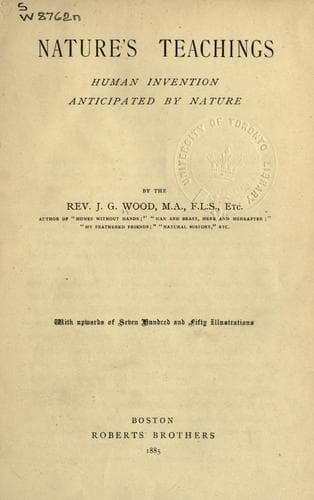
Nature's Teachings: Human Invention Anticipated by NatureWood, J. G. (John George)
History
Nature's Teachings: Human Invention Anticipated by Nature
Wood, J. G. (John George)
Inventions; Natural history
Springs and their various Structure.--The Elastic Spring.--The
Boy’s Catapult and its Powers.--The Pistolograph, its Principle,
and Uses to which it can be put.--Leaf-rolling Caterpillars, and
their Way of Work.--The Carriage Spring.--The Horse’s Hoof and its
complex Structure.--Fungi and their united Power.--The Chinese
Cross-bow.--The ancient Balista.--Skull of the Crocodile.--Bones of
young Children.--The Spiral Spring and its many Uses.--The
Toy-gun.--The Needle-gun.--Valved Brass Instruments.--Watch and
Clock Springs.--The Bed Spring.--Parallels in Nature and
Art.--Buffers of Railway Carriages.--Spring Solitaires.--The Bell
Spring.--Spiral Springs in Vegetable Tissues.--Poison Cells of
various Marine Animals.--Effects of the Spiral Springs.
ELASTIC SPRINGS.
Here we come upon a subject so large, that it is difficult to define its
exact requisite limits. The principle of the elastic spring pervades all
Nature, and the numerous adaptations in Art are closely, though perhaps
not directly, attributable to the wide distribution of the spring in
Nature.
There is, for example, the simple elasticity which enables a tree, when
bowed by the wind, to spring back so soon as the pressure is removed,
and which, indeed, is the power which enables a bow to propel an arrow.
Then there are spiral springs innumerable, many of them so minute that
they can only be seen by the aid of the microscope, and there are many
springs which exhibit their elasticity by their power of extension and
shortening, just as is done with the elastic fabrics which are so much
in vogue at the present day, and which seem so necessary to ordinary
comfort that we feel disposed to wonder how our forefathers managed
without them.
We will now proceed to examine some of these springs in detail.
* * * * *
THERE is one form of elastic spring which has of late years become more
familiar than agreeable, namely, the toy which is learnedly called a
“catapult,” though it has little in common with the ancient weapon whose
name it bears.
As may be seen by reference to the illustration, it consists of one or
more india-rubber straps attached to a fork-like handle, and carrying a
small pouch in which is contained the missile. Although it is not
remarkable for accuracy, it can throw a stone or a bullet a considerable
distance, and its power can be very quickly increased by adding to the
number of the straps. Thus a catapult has been made which was capable of
sending a small pistol bullet through a wooden board, so that the
child’s toy might really become a dangerous weapon.
Indeed, cases are known where the catapult has hurled a stone with fatal
effect upon human beings. In my own neighbourhood there are many
examples of glass being pierced by stones thrown from catapults just as
if they had been subjected to bullets shot from firearms, the holes
being quite small and round.
Public-domain text, read in full here on John Shaqi.
Reviews
Reviews
No reviews yet
Be the first to share your thoughts on this work.
Elsewhere in the archive
Join the Discussion
Join the discussion
Sign in to leave a comment or review.
Sign InorCreate an account