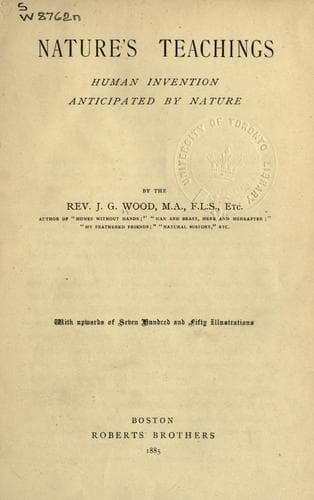
Nature's Teachings: Human Invention Anticipated by NatureWood, J. G. (John George)
History
Nature's Teachings: Human Invention Anticipated by Nature
Wood, J. G. (John George)
Inventions; Natural history
On the extreme left are shown the head and closed lancets of a foreign
Gad-fly, the lancets being all in their sheaths, and showing the
character of the weapon which enables a small fly to be master, or
rather mistress, of the forest. I say mistress, because in all these
cases it is the female alone that possesses these instruments of
torture.
Next it is a magnified representation of the lancets of the common
Mosquito, as seen from above, both lancets being removed from their
sheaths and separated.
WAR AND HUNTING.
CHAPTER IV.
The Net, as used in Hunting and War.--The Seine-net, as used for
Fishing.--Also as a means of Hunting.--Net for
Elephant-catching.--Steel Net for Military Purposes.--Web of the
Garden Spider.--The Casting-net, as used in Fishing.--Also as
employed in the Combats of the ancient Circus.--Various Kinds of
Casting-nets.--The Argus Star-fish and the Barnacle.--The Rod and
Line.--Angling of various Kinds.--The Polynesian as an Angler.--The
Angler-fish.--“Playing” a Fish.--The Nemertes and its Mode of
Feeding.--Mr. Kingsley’s Account of it.--Power of Elongation and
Contraction.--The Cydippe.--Spring-traps.--The Gin, Rat-trap, and
Man-trap.--Jaws of Dolphin, Porpoise, and Alligator.--Legs of
Phasma.--Baited Traps.--Carnivorous Plants and their Mode of
Feeding.--Birdlime.--“Pegging” for Chaffinches.--Curious Mode of
Tiger-killing.--Ant-eater and its Mode of Feeding.--The
Drosera.--Web of Spider and its Structure.
THE NET.
Although the Net is but seldom employed for the purposes of general
warfare, it was once largely used in individual combats, of which we
will presently treat. In hunting, however, especially in fishing, the
Net has been in constant use, and is equally valued by savages and the
most civilised nations.
To begin with the fisheries. Even among ourselves there are so many
varieties of fishing-nets that even to enumerate them would be a work of
time. However, they are all based on one of two principles, _i.e._ the
nets which are set and the nets which are thrown.
We will begin with the first.
* * * * *
ON the right hand of the illustration, and at the bottom, may be seen a
common Seine-net being “shot” in the sea. This form of net is very long
in proportion to its width, some of these nets being several miles long.
The upper edge of the net is furnished with a series of cork bungs,
which maintain it on the surface, while the lower edge has a
corresponding set of weights, which keep the net extended like a wall of
meshes. Any fish which come against this wall are, of course, arrested,
and are generally caught by the gill-covers in their vain attempts to
force themselves through the meshes.
Public-domain text, read in full here on John Shaqi.
Reviews
Reviews
No reviews yet
Be the first to share your thoughts on this work.
Elsewhere in the archive
Join the Discussion
Join the discussion
Sign in to leave a comment or review.
Sign InorCreate an account