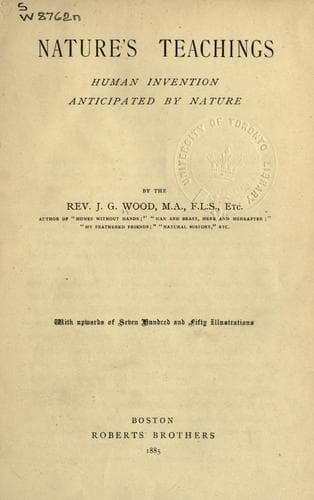
Nature's Teachings: Human Invention Anticipated by NatureWood, J. G. (John George)
History
Nature's Teachings: Human Invention Anticipated by Nature
Wood, J. G. (John George)
Inventions; Natural history
This is very well in sea-fishing, where a line made of whip-cord will
answer the purpose in most cases. But, in river fishing, we have the
fact that the fish are so shy that a linen thread would scare them, and
so strong and active, that even whip-cord would not prevent them from
breaking the line, or tearing the hook out of their mouths. So the
modern angler sets himself to the task of combating both these
conditions. In the first place, he makes the last yard or two of his
line of “silkworm-gut”--a curious substance made from the silk-vessels
of silkworms, and nearly invisible in the water. In the next place, he
has a very elastic rod; and, in the third, he has forty or more yards of
line, though perhaps only twenty feet are in actual use until the fish
is hooked. The remainder of the line is wound upon a winch fixed to the
handle of the rod. Thus, when a powerful fish is hooked and tries to
escape, the line is gradually let loose, so as to yield to its efforts.
When it becomes tired by the gradual strain, the line is again wound in,
and in this way a fish which would at the first effort smash rod and
line of a novice will, in the hands of an experienced fisherman, be
landed as surely as if it were no bigger than a gudgeon.
* * * * *
NATURE has in this case also anticipated Art, and surpassed all her
powers.
[Illustration: NEMERTES. “PLAYING” A FISH.]
There is a wonderful worm, common on our southern coasts, and bearing,
as far as I know, no popular name. It is known to the scientific world
as _Nemertes Borlasii_. It possesses the power of extension and
contraction more than any known creature, and uses those powers for the
purpose of capturing prey. The fishermen say that this worm can extend
itself to a length of ninety feet, and as Mr. Davis found one to measure
twenty-two feet, after being immersed in spirits of wine, it is likely
that their account may be true, especially as the spirit greatly
contracted the animal in point of length.
A most vivid description of this worm is given by C. Kingsley, in his
“Glaucus,” and was written before he knew its name.
“Whether we were intruding or not, in turning this stone, we must pay a
fine for having done so; for there lies an animal as foul and monstrous
to the eye as ‘hydra, gorgon, or chimæra dire,’ and yet so wondrously
fitted to its work that we must needs endure for our own instruction to
handle and to look at it. Its name I know not (though it lurks here
under every stone), and should be glad to know. It seems some very ‘low’
Ascarid or Planarian worm.
“You see it? That black, shiny, knotted lump among the gravel, small
enough to be taken up in a dessert spoon. Look now, as it is raised and
its coils drawn out. Three feet, six, nine at least; with a capability
of seemingly endless expansion; a slimy tape of living caoutchouc, some
eighth of an inch in diameter, a dark chocolate black, with paler
longitudinal lines.
Public-domain text, read in full here on John Shaqi.
Reviews
Reviews
No reviews yet
Be the first to share your thoughts on this work.
Elsewhere in the archive
Join the Discussion
Join the discussion
Sign in to leave a comment or review.
Sign InorCreate an account