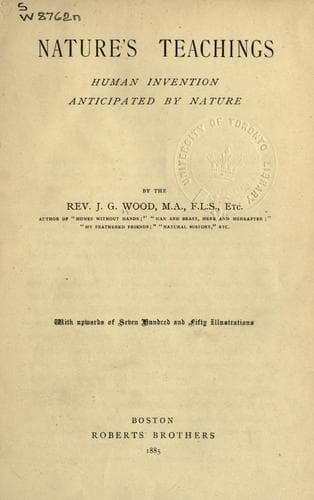
Nature's Teachings: Human Invention Anticipated by NatureWood, J. G. (John George)
History
Nature's Teachings: Human Invention Anticipated by Nature
Wood, J. G. (John George)
Inventions; Natural history
Below the Ant-eater is the common Drosera, or Sundew, one of our British
carnivorous plants. It captures insects, just as has been narrated of
the Dionea. But, instead of the leaf closing upon the insect, it arrests
its prey by means of little globules of viscous fluid, which exude from
the tips of the hairs with which the surface of the leaf is covered. As
soon as the insect touches the hairs, they close over it, bind it down,
and keep it there until it is digested. Several species of Drosera are
known in England, and are found in wet and marshy places.
Another plant, the Green-winged Meadow Orchis (_Orchis morio_), has been
known to act the part of the Drosera. A fly had contrived to push its
head against the viscous fluid of the stigmatic surface, and, not being
able to extricate itself, was found sticking there.
Next comes a portion of the web of the common Garden Spider (_Epeira
diadema_). We have already treated of this web as a net, and we will now
see how it comes within the present category.
In the web of the spider there are at least two distinct kinds of
threads. Those which radiate from the centre to the circumference are
strong and smooth, while those which unite them are much slighter, and
are covered with tiny globules set at regular intervals. When the web is
newly spun, these globules are found to be nearly as tenacious as
birdlime, and it is by these means that an insect which falls into the
web is arrested, and cannot extricate itself until the spider can seize
it. After awhile the globules become dry, refuse to perform their
office, and then the spider has to construct another web. So numerous
are these globules that, according to Mr. Blackwall’s calculations, an
ordinary net contains between eighty and ninety thousand. Below the
figure of the web itself are shown the two kinds of thread, the upper
bearing the globules, and the lower representing one of the plain
radiating threads.
WAR AND HUNTING.
CHAPTER V.
Reverted Spikes and their Modifications.--The Wire
Mouse-trap.--George III. and the Trap.--Fate of a Royal
Finger.--The Crab and Lobster Pot.--The Eel-pot.--Cocoon of the
Emperor-moth and its Structure.--“Catchpoll” of the Middle
Ages.--Deer-trap of India.--Jaws of Pike and Serpent.--The
Grass-snake.--Jaws of Shark and their Power.--Spiked Defences.--The
Park Fence, the Garden Wall, and the Chevaux-de-frise.--The
“Square” of Infantry Manœuvres.--The Abattis, and its Structure
and Power.--Ranjows and Caltrops.--Ancient Ranjows in
Ireland.--Hedgehog.--Porcupine Echidna.--House-builder Caterpillar
and its Home.--Repagula of Ascalaphus.--Tearing Weapons.--The
“Wag-nuk” of India.--Armed Gauntlet of the Middle
Ages.--Shark-tooth Gauntlet of Samoa, and the Uses to which it was
put.--A terrible Warrior.--The Tiger’s Claw.--Sport and Earnest.
REVERTED SPIKES.
Public-domain text, read in full here on John Shaqi.
Reviews
Reviews
No reviews yet
Be the first to share your thoughts on this work.
Elsewhere in the archive
Join the Discussion
Join the discussion
Sign in to leave a comment or review.
Sign InorCreate an account